Health Articles
Knowledge
Swollen knee, inability to bend the knee: warning signs of knee osteoarthritis that must be watched!
NUTTAVUT PHAISINSOMBOON, M.D.
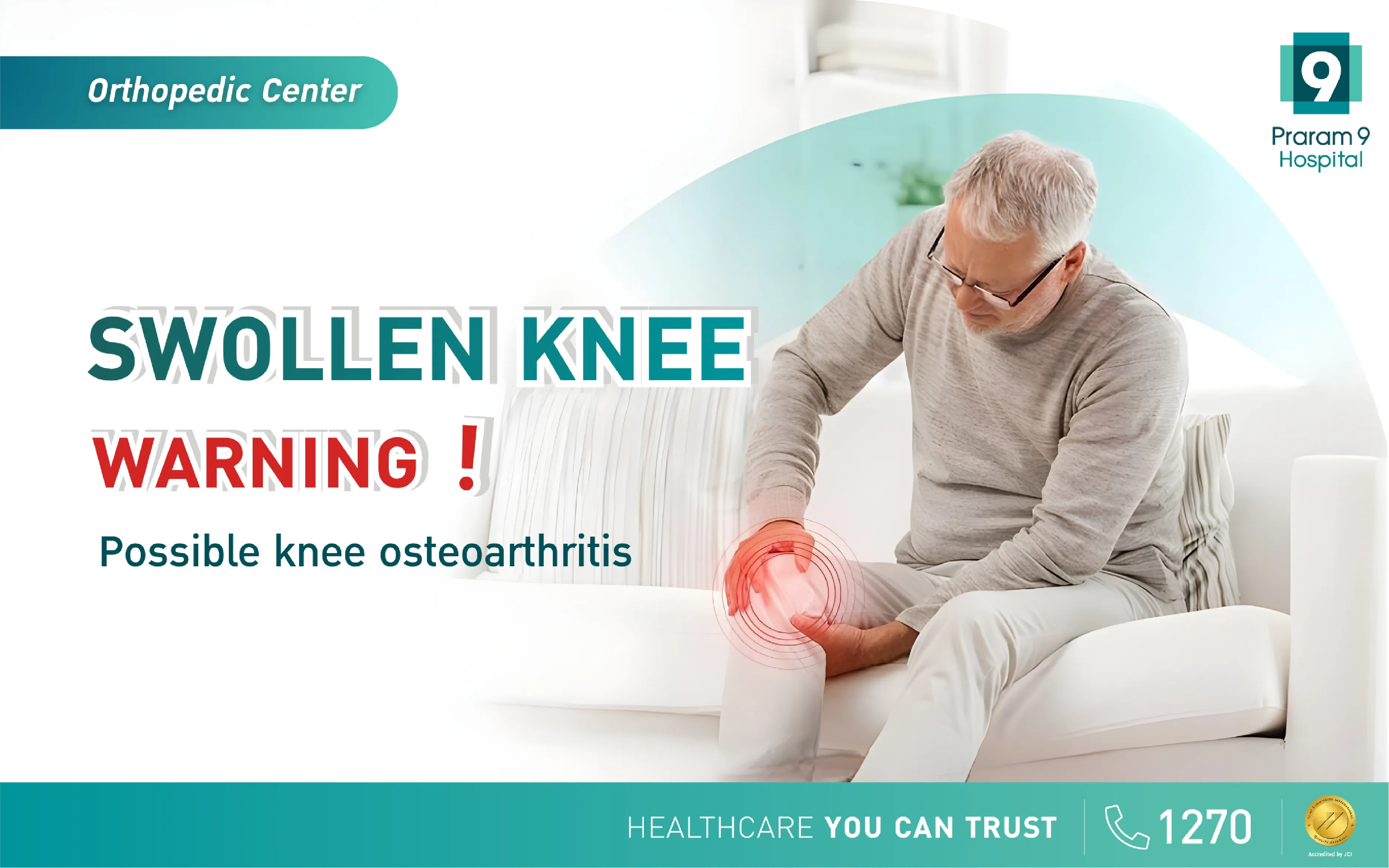
Swollen knee is a condition commonly found in people of all ages, from athletes to the elderly. It may be caused by many reasons, such as injury from accidents, inflammation of the joint, or chronic diseases such as knee osteoarthritis. Although knee swelling may seem not severe in the early stage, if left for a long time without appropriate treatment, it may lead to complications or loss of knee joint movement. Therefore, understanding the causes, associated symptoms, and initial care approaches is important to help prevent chronic problems in the future.
Key Takeaways
- Swollen knee is a condition in which fluid accumulates in the knee joint more than normal, causing the knee to appear enlarged, feel tight, tense, or painful during movement.
- Excessive use of the knee joint may lead to inflammation, injury, and result in knee swelling.
- Swollen knee may be a sign of various diseases such as rheumatoid arthritis, gout, or knee osteoarthritis.
What is a swollen knee?
A swollen knee is a condition in which fluid accumulates in the knee joint more than normal, causing the knee to appear enlarged, feel tight, tense, or painful during movement. This swelling can occur from many causes, such as acute injury, inflammation of tissues or the synovial membrane, to chronic diseases related to joints such as knee osteoarthritis or gout.
Medically, knee swelling may be called “fluid in the knee” or Joint Effusion, which means abnormal accumulation of fluid (such as synovial fluid or blood) within the joint space, resulting in knee pain, knee swelling, and causing difficulty in walking, especially when bearing weight on the knee.
What are the risk factors that may cause a swollen knee?
Knee injury from accidents
Accidents that damage the articular cartilage, meniscus, anterior cruciate ligament (ACL), posterior cruciate ligament (PCL), and synovial membrane, because these 5 structures are important components that make the knee strong. If impacted, it may cause the knee joint to dislocate or swell.
*Read more about anterior cruciate ligament injury in the article: Torn ACL, athletes should be careful, treat early before risk of osteoarthritis
Excessive use of the knee joint
Overuse of the knee joint may lead to inflammation, injury, and result in knee swelling. Therefore, those who have daily activities that require running or walking for long periods, heavy lifting, or enjoy high-impact sports such as football and basketball may be at risk of knee swelling.
Overweight
Overweight or obesity is one of the important risk factors that cause knee swelling, because the knee joint is the main joint that bears almost all of the body weight during standing, walking, running, or climbing stairs.
Joint infection
A condition caused by pathogens such as bacteria, viruses, or fungi entering the joint and causing acute inflammation, which is one cause of knee swelling with redness, warmth, and severe pain.
What are the characteristics of knee swelling?
Knee swelling can be observed from abnormal sensations in the knee joint area. Common characteristics are as follows:
- The knee appears larger or more protruding than normal when compared with the other knee; the affected knee may look swollen, bulging, or clearly changed in shape.
- Feeling tight, tense, or heavy in the knee joint; patients often feel the knee is tight, cannot move fully, or feel pressure inside the joint.
- Pain when moving or upon touch; pain may range from mild to severe, especially when moving the knee, walking, or standing for long periods.
- Difficulty in movement; the ability to straighten or bend the knee may decrease, feeling stiff or stuck when moving.
- Warm or red sensation around the knee; if there is inflammation or infection, the skin around the knee may be red, warm, or feel hotter than normal.
- Abnormal sounds or sensations in the joint; some may feel a “popping” or “cracking” sound when moving the knee and may have accompanying pain.
Swollen knee: what diseases can it indicate?
If you find that you start to have knee swelling, difficulty walking, and pain when bearing weight, it should not be left untreated, because knee swelling may be a sign of the following diseases:
- Knee osteoarthritis (Osteoarthritis)
Caused by degeneration of cartilage in the knee joint due to age or heavy use
Swelling occurs from inflammation in the joint
Often has dull pain and stiffness, especially in the morning or after sitting for a long time
- Rheumatoid arthritis (Rheumatoid Arthritis)
An autoimmune disease that damages joints, causing chronic inflammation
Swollen, red, warm knees and pain often occur in multiple joints simultaneously
Often has morning stiffness lasting more than 30 minutes
- Gout
Caused by accumulation of uric acid in the joint
Knee swelling with redness, warmth, and very severe acute pain, especially at night
Often starts in one joint first, such as the toe joint, then spreads to the knee
- Septic arthritis (Septic Arthritis)
Caused by bacteria or viruses entering the joint
Swollen, red, warm knee with high fever and severe pain
It is an emergency condition that must be treated quickly
- Baker’s cyst (Baker's Cyst)
A fluid-filled sac caused by accumulation of joint fluid at the back of the knee
May cause swelling and tightness at the back of the knee, pain when bending the knee
Often associated with joint diseases such as osteoarthritis or arthritis
- Prepatellar bursitis, Patellar tendinitis
Inflammation of the bursa in front of the kneecap, causing obvious swelling in that area
Patellar tendon inflammation may have redness and warmth of the skin around the knee, resulting in the knee appearing swollen
How can a swollen knee be treated?
Treatment methods for a swollen knee depend on the severity of the symptoms. In general, the treatments are as follows:
1. Treatment with medication
Treatment of a swollen knee with medication can include both topical and oral drugs that have properties to reduce pain. Medication treatment focuses on patients with mild swelling or pain, to monitor initial symptoms and prepare for further treatment if symptoms do not improve.
2. Treatment with injections
If knee pain and swelling are severe, the doctor may consider steroid injection to reduce inflammation. If caused by infection, antibiotics must be given as advised by the doctor. In addition, in cases where knee swelling is caused by specific diseases such as gout, medication for that disease may also be required. In this regard, diagnosis and care by a doctor should be obtained before using any medication for safety and appropriate treatment outcomes.
3. Treatment with surgery
Surgical treatment for a swollen knee is used in cases where swelling is caused by problems within the knee joint that cannot be treated by other methods such as medication or physical therapy. The surgical approaches are as follows:
- Arthroscopic surgery: using a camera and small instruments inserted into the knee joint to treat abnormalities such as meniscus tear, ligament tear, or loose bone fragments in the joint, which are causes of swelling and pain
- Arthrocentesis: if there is a large accumulation of fluid in the knee joint, the doctor may perform aspiration or drainage by surgical method to relieve swelling
- Knee replacement: used in patients with severe knee osteoarthritis and chronic swelling, by replacing the damaged joint surface with artificial material to reduce pain and swelling in the long term
Surgery will be considered based on the cause of swelling, severity of the disease, and response to other treatments, with a specialist doctor evaluating and planning the treatment.
4. Treatment with physical therapy
Treatment of a swollen knee with physical therapy aims to reduce swelling, restore movement, and strengthen the muscles around the knee.
Understand knee swelling, recognize disease early, and treat correctly at the joint care center, Praram 9 Hospital
Swollen knee is a symptom caused by accumulation of fluid or inflammation within the knee joint, which may have many causes such as injury, excessive joint use, infection, arthritis, or patellar inflammation. Knee swelling may be accompanied by pain, redness, warmth, or limited joint movement.
Diagnosing the true cause is important because treatment methods vary depending on the cause. Appropriate initial care, such as cold compress in the early stage and resting the joint, can help reduce swelling and pain.
For those who have knee swelling and do not improve after cold compress, it is recommended to receive diagnosis from a specialist doctor at the joint care center of Praram 9 Hospital. Currently, problems related to bones, joints, and the musculoskeletal system can be treated more effectively with the use of computer-assisted surgical systems, which help increase accuracy and reduce risks in treatment.
In addition, there is robotic arm technology for knee replacement surgery that helps increase surgical accuracy, faster recovery, and improve treatment quality, resulting in patients being able to return to daily life with confidence and better quality of life.
For more information
Facebook : Praram 9 Hospital International & Expats
Line : @Praram9Hospital
Tel. 1270
Frequently asked questions about knee swelling
1. What type of swollen knee should urgently see a doctor?
Although some cases of knee swelling may not be severe and can resolve on their own, there are certain characteristics that are warning signs and should prompt immediate medical consultation to prevent complications or more severe disease, as follows:
- Sudden knee swelling after an accident or fall
- Severe knee pain to the point of inability to walk or move
- Swollen, red, warm knee with fever
- Deformed or misaligned knee joint
- Chronic or recurrent knee swelling without known cause
- Clear swelling at the back of the knee
- Knee swelling with pain in multiple joints
- History of joint diseases such as gout or rheumatoid arthritis
2. Knee pain and swollen knee: should use hot or cold compress?
Knee swelling can be treated with both hot and cold compress depending on the duration of knee pain.
- Cold compress: in the first 24–48 hours, helps reduce pain and causes blood vessels to constrict, reducing swelling. It is recommended to use a cold gel pack or ice wrapped in cloth placed on the knee for 20–30 minutes each time, 2–3 times per day.
- Hot compress: if knee pain or swelling lasts more than 48 hours, helps dilate blood vessels to increase blood circulation and reduce pain. Use a cloth soaked in hot water or a hot pack with temperature not exceeding 48 degrees, 15–20 minutes each time, 2–3 times per day. Be cautious that if there is an open wound, hot compress should not be used as it may worsen inflammation.
However, if cold compress during the first 24–48 hours does not improve symptoms, it is recommended to see a doctor for diagnosis and targeted treatment planning.
References
National Library of Medicine (U.S.). (2025, April 15). Knee Injuries and Disorders (https://medlineplus.gov/kneeinjuriesanddisorders.html)
Edema. (2024, June 25). Cleveland Clinic. https://my.clevelandclinic.org/health/symptoms/17678-swollen-knee