Health Articles
Knowledge
Get to know ‘Psoriasis’, a skin disease from the immune system that cannot be completely cured
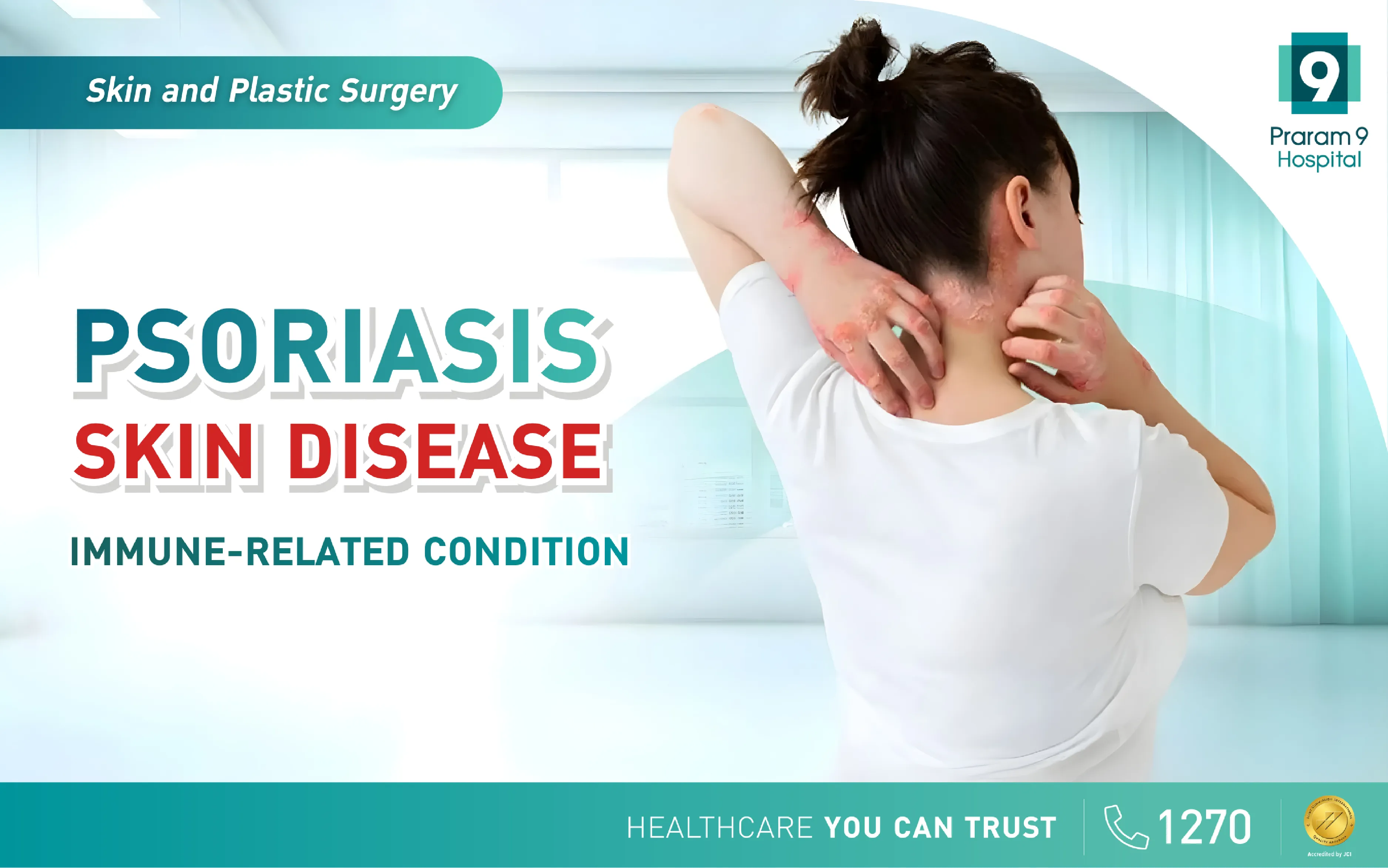
Psoriasis is not just a rash, but a signal of an abnormal functioning immune system, which results in inflammation of skin cells and faster-than-normal cell division. Although this disease still cannot be completely cured at present, being aware of the symptoms, causes, and triggering factors is the first and most important step that will help you control the disease and return to living with confidence again
Key Takeaways
- Psoriasis is not a contagious disease, but a chronic inflammatory skin disease from abnormal immune function, causing red, thick, raised, scaly rashes. It can be found in many areas throughout the body
- Psoriasis cannot be completely cured at present, but symptoms can be controlled in various ways such as topical medications, UVB/PUVA phototherapy, oral medications, and biologic drugs
- Dry skin, itching, and scaling should not be overlooked. Early detection and early care lead to better disease control, helping reduce flare-ups and reduce the risk of complications such as psoriatic arthritis, which increases pain for patients
What is Psoriasis?
Psoriasis (Psoriasis Vulgaris) is a type of chronic inflammatory skin disease related to abnormalities of the immune system, causing the skin to shed cells faster than normal, resulting in red rashes, dry skin, thick raised lesions, and scaly flakes resembling scales on the skin. Some patients may feel pain, burning, or itching as well
Psoriasis rashes can occur in many areas such as the scalp, elbows, knees, back, trunk, or even the nails and finger webs, which may affect daily life, including long-term confidence of patients
Although psoriasis is a chronic disease that cannot be completely cured, there are currently various and effective treatment approaches that can help control symptoms, reduce flare-ups, and allow patients to regain a better quality of life again
How many types of psoriasis are there? Knowing helps observe symptoms faster
Psoriasis has many types that present with different symptoms. Knowing the types of the disease helps to better understand one’s symptoms and allows appropriate care from the early stage
1. Plaque Psoriasis (thick plaque psoriasis)
This is the most common type, accounting for 80–90%. The characteristic feature is red, thick, raised plaques with white or silvery scales, commonly found on elbows, knees, scalp, trunk, or areas with frequent friction
2. Guttate Psoriasis (drop-like psoriasis)
This type has lesions as small drop-shaped rashes scattered over the trunk, arms, and legs. Bacterial infection, especially in the respiratory system such as sore throat, is an important triggering factor. It is commonly found in adolescents and young people
3. Inverse Psoriasis (red rash in skin folds)
This type usually presents as smooth red rashes without obvious scales, commonly found in areas with high friction such as the armpits, groin, under the breasts, or around the genital area. It is often painful, burning, and easily irritated
4. Pustular Psoriasis (pustular type)
This type presents as small white pustules on red skin. It may occur locally such as on the palms or soles. In severe cases, it may occur throughout the body together with fever
5. Erythrodermic Psoriasis (generalized redness)
This is a rare but very severe form. Patients will have red, peeling skin over the entire body, may have fever and chills. It can occur acutely requiring urgent treatment, or occur chronically long-term. Patients may have had plaque psoriasis before
6. Nail Psoriasis
Patients will have nail changes such as pitting, thickening, or discoloration of the nails, which is often found together with other types of psoriasis
7. Palmoplantar Psoriasis (hands and feet)
This type has lesions on the hands and feet. Patients will have clearly bordered red rashes on the palms and soles. If it progresses, lesions may occur on the backs of the hands or feet as well
8. Sebopsoriasis (overlap with seborrheic dermatitis)
This type overlaps with seborrheic dermatitis, often presenting as greasy scales on the scalp. Patients will have lesions on the scalp, ears, face, and chest, which occur from seborrheic dermatitis
What causes psoriasis?
Psoriasis is caused by abnormal functioning of the body’s immune system, which stimulates inflammation in the skin, causing skin cells to be destroyed to stimulate rapid creation of new skin cells. Then the immune system continues to cause inflammation and destroy the skin repeatedly until thick raised plaques accumulate on the skin and eventually form scaly flakes similar to dandruff
Psoriasis can be triggered by many factors as follows
- Genetics, found in up to 1 in 3 patients with psoriasis. Those with family members who have psoriasis are more likely to develop the disease
- Viral and bacterial infections. Although viruses and bacteria do not directly cause psoriasis, they can disrupt the immune system, making them an important triggering factor
- Stress, insufficient rest, causing the immune system to weaken and function abnormally
- Unsuitable environment such as extremely hot or cold weather, making the skin more prone to inflammation
- Use of certain medications such as lithium or Beta-blockers
- Skin injury from wounds or surgery
What are the symptoms of psoriasis?
Psoriasis can present with various symptoms depending on the type and location of the rash. Being aware of early symptoms helps receive treatment quickly and reduce the risk of flare-ups or complications in the future. Common symptoms include
- Red, inflamed rashes with clear borders
- Thick, raised skin with white-silvery scales
- Itching, burning, or pain at the rash area
- Dry scalp with flaking similar to dandruff
- Nail abnormalities such as pitting, thickening, or separation from the nail bed
- Rashes may occur in one or multiple areas such as elbows, knees, back, trunk, or skin folds
- In severe cases, there may be generalized redness or pustules
If there are symptoms resembling psoriasis even slightly, a doctor should be consulted for accurate evaluation, because appropriate treatment from the beginning helps better control the disease
How is psoriasis diagnosed? What methods do doctors use to diagnose the disease
Diagnosis of psoriasis is an important step that helps patients receive correct and targeted treatment, because symptoms may resemble other skin diseases. Without accurate evaluation, it may lead to incorrect treatment and worsening symptoms. Diagnosis generally consists of
- History taking
The doctor will ask about the history of the rash, duration, suspected triggering factors, and family history of psoriasis, since this disease is often related to genetics
- Physical examination by observing characteristics
A dermatologist can diagnose psoriasis from characteristic features such as thick red raised plaques with clear borders and white-silvery scales, including the location of rashes such as elbows, knees, scalp. Examination of nails and scalp is also performed to find abnormalities associated with psoriasis such as nail pitting, thickened nails, or scalp lesions
- Skin scraping or biopsy (Skin Biopsy)
In cases where symptoms are unclear or confirmation is needed, the doctor may take a small skin sample for pathological examination in the laboratory to accurately differentiate psoriasis from other skin diseases
- Assessment of other associated symptoms
Psoriasis may present with symptoms other than skin manifestations such as joint pain, joint swelling, or stiffness, which may indicate psoriatic arthritis that requires additional care
Can psoriasis be treated? What are the treatment methods?
Although psoriasis is a chronic disease that cannot be completely cured, there are currently various treatments that effectively control symptoms, reduce inflammation, and calm rashes. Doctors will consider and plan treatment individually, with the following approaches
1. Topical Medications
For patients with mild to moderate lesions, doctors often prescribe topical medications. These include several types depending on symptoms, for example
- Corticosteroids, the most commonly used drugs, reduce inflammation, redness, itching, and thickness of plaques effectively, but should not be used continuously as they may thin the skin and suppress adrenal gland function
- Vitamin D derivatives (Calcipotriol), reduce abnormal rapid skin cell production and turnover, helping reduce plaque thickness. Can be used alone or with corticosteroids to reduce side effects and improve effectiveness
- Coal tar preparations, reduce inflammation, itching, and slow skin cell division. Suitable for mild lesions or scalp, but have a strong odor and may cause irritation in some patients
- Non-steroidal anti-inflammatory topical agents (Calcineurin Inhibitors) such as Tacrolimus or Pimecrolimus, used for sensitive areas such as the face or around the eyes. They do not cause skin thinning like steroids but should not be used continuously due to potential increased cancer risk and should be used under medical supervision only
- Skin moisturizers, help increase skin moisture and reduce irritation, commonly used in all levels of treatment
2. UV Phototherapy
Phototherapy helps reduce inflammation and skin cell division, suitable for patients with widespread lesions. There are 2 types used
- Narrowband UVB (NB-UVB), the most commonly used method, highly safe, reduces inflammation and skin turnover, suitable for all types including children and pregnant women. Treatment requires 2–3 sessions per week for at least 3 months
- PUVA Therapy, combines ultraviolet A with Psoralen to increase skin sensitivity to light, suitable for severe lesions, palms, soles, or those not responsive to UVB. Not suitable for pregnant women or children due to risk of skin thinning and eye effects
3. Oral and Injected Medications
Used in moderate to severe cases with lesions covering more than 10% of total body surface area. Medications include Methotrexate, Cyclosporine, or retinoids, which require close medical supervision
Currently, biologic drugs are available as injectable treatments targeting the immune system directly, suitable for patients not responding to other treatments, with high effectiveness in controlling rashes and reducing flare-ups
Psoriasis: early detection leads to better control
Although psoriasis is a chronic disease, early detection and appropriate treatment from the beginning help control symptoms well, reduce flare-ups, and prevent complications such as psoriatic arthritis, which may affect long-term daily life
Skin and Plastic Surgery Center, Praram 9 Hospital is ready to provide care with sincerity, by specialized dermatologists and modern equipment, allowing patients to receive appropriate treatment to control the disease and return to a good quality of life again
For more information
- Facebook: Praram 9 Hospital International & Expats
- Line : @Praram9Hospital
- Tel. 1270
Frequently asked questions about psoriasis
1. What complications can psoriasis cause?
Poorly controlled psoriasis may lead to complications in multiple systems including
- Psoriatic arthritis, causing joint pain, stiffness, and swelling
- Cardiovascular disease
- Stroke
- Hypertension
- Eye diseases such as conjunctivitis, blepharitis, red eye
- Skin discoloration from repeated inflammation
- Obesity
- Diabetes
- Other autoimmune diseases
Additionally, having psoriasis may cause loss of confidence and may affect mental health
2. How is psoriasis transmitted?
Psoriasis is not a contagious disease, therefore it cannot be transmitted to others
References
Psoriasis. (2022, November 15). Cleveland Clinic. https://my.clevelandclinic.org/health/diseases/6866-psoriasis
Mayo Clinic Staff. (2025, February 21). Psoriasis. Mayo Clinic. https://www.mayoclinic.org/diseases-conditions/psoriasis/symptoms-causes/syc-20355840
endon, A., & Schäkel, K. (2019). Psoriasis Pathogenesis and Treatment. International journal of molecular sciences, 20(6), 1475. https://doi.org/10.3390/ijms20061475