Health Articles
Knowledge
Is Chocolate Cyst Dangerous? Understand Causes, Symptoms, and Treatment
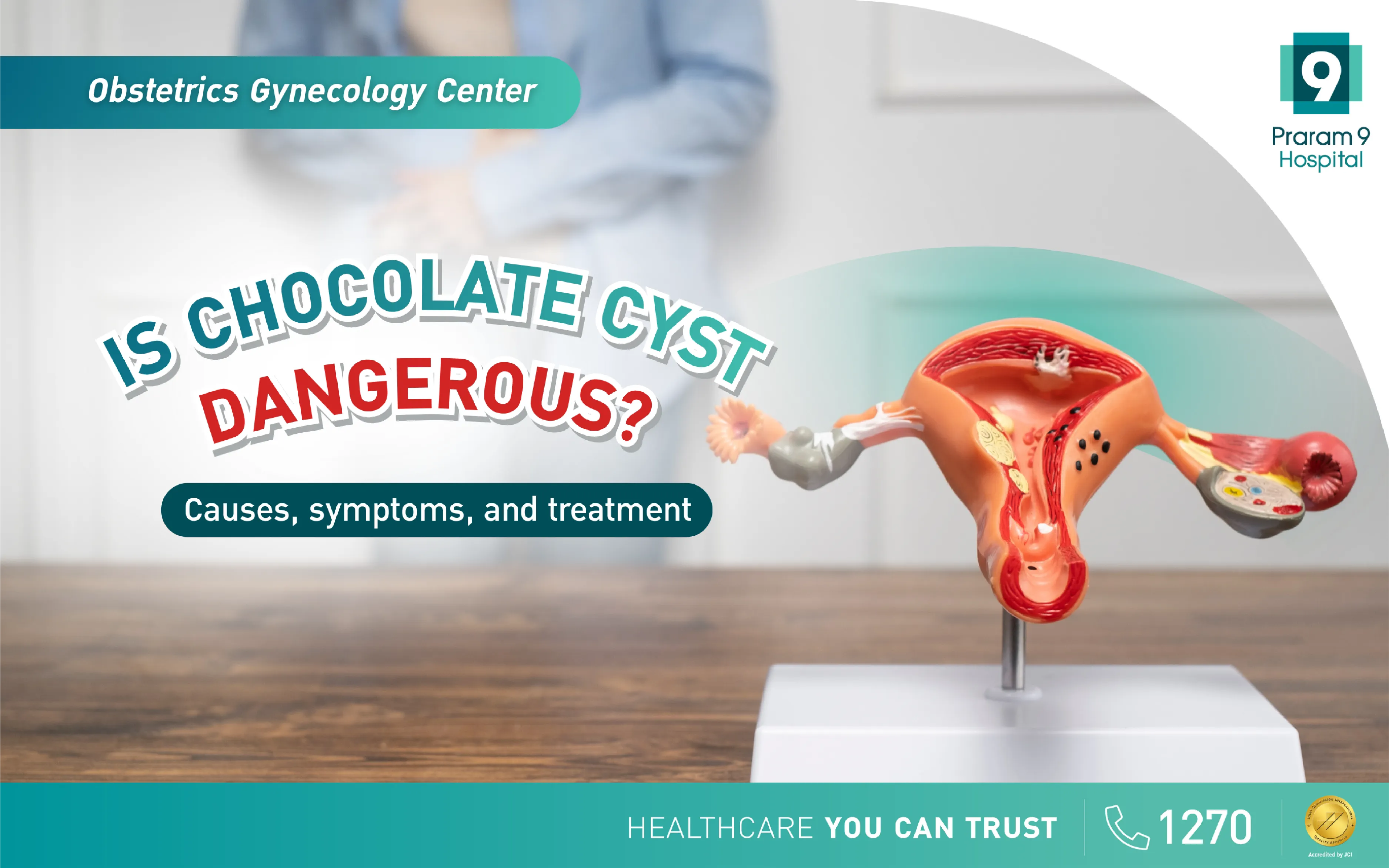
Chocolate cyst is a type of cyst (fluid-filled sac) that commonly occurs in women of reproductive age. A common symptom is pain during menstruation, which may make you think it is just normal menstrual cramps, so you may not notice that you are facing symptoms of a chocolate cyst. If not diagnosed from the beginning, the symptoms may progress and become more difficult to treat.
This article will take you to understand the causes, symptoms, and treatment methods, along with answering the question of whether chocolate cyst is dangerous, in order to serve as a guideline for you to observe yourself when having menstrual pain and to cope with this disease correctly.
Key Takeaways
- Ovarian chocolate cyst is a disease that commonly occurs in women of reproductive age, caused by tissue that should be in the uterine cavity being located in the wrong place, especially in the ovary.
- Currently, there are 2 treatment methods: medication to inhibit the growth of the chocolate cyst and surgery to remove the chocolate cyst.
What causes chocolate cyst?
There are several assumptions about the cause of chocolate cyst, but it is mostly believed to be caused by retrograde menstruation from the uterine cavity back into the abdominal cavity through the fallopian tubes, together with an abnormal mechanism for eliminating endometrial cells. These cells then implant on organs in the pelvic cavity such as the ovaries, fallopian tubes, peritoneum, ureters, and intestines, and can also infiltrate into the uterine muscle. This condition is called endometriosis. Therefore, when menstruation occurs, these endometrial cells will also produce menstrual bleeding. When such blood accumulates, it forms a cyst in the ovary, appearing as brown fluid which is old blood inside, hence the name chocolate cyst (Endometrioma). The menstruation produced in these various locations becomes a foreign substance causing inflammation in the pelvic cavity. In addition to causing abdominal pain, it also causes adhesions, resulting in a risk of chronic pelvic pain, infertility, and pain during sexual intercourse.
Common symptoms from such lesions are more severe menstrual pain than usual and progressively increasing pain.
What symptoms indicate risk of chocolate cyst?
Initial symptoms that may indicate this condition include:
- More severe menstrual pain than usual, increasing progressively
- Lower abdominal pain during sexual intercourse
- During menstruation, pain radiating to the rectum, loose stools
- Chronic lower abdominal pain
- Infertility
- Other symptoms are related to the organs where endometrial tissue grows abnormally and the size of the mass, often occurring during menstruation. For example, if lesions are in the bladder area, there may be blood in the urine during menstruation, or if lesions are in the large intestine, there may be blood in the stool.
At the same time, complications may occur, such as rupture of a chocolate cyst, which often causes severe and sudden lower abdominal pain at the cyst area, or in the case of infection, it may cause abdominal pain, as well as fever and nausea and vomiting. Therefore, if you have such symptoms and suspect a chocolate cyst, you should promptly see a doctor for diagnosis as soon as possible.
Suspecting a chocolate cyst, how to know for sure?
When you suspect that your symptoms are at risk of being a chocolate cyst, it is recommended to see a specialist doctor to diagnose your pain with certainty. Initially, the doctor will take the patient’s history, then perform a physical examination and pelvic examination. If there is suspicion of a chocolate cyst in the body, the doctor will perform more detailed examinations using pelvic ultrasound through the abdomen or through the vagina.
The diagnostic method will be considered by the doctor according to appropriateness depending on the patient’s physical condition and the characteristics of the symptoms. Therefore, each patient may receive different examination methods. After that, the doctor will plan further treatment.
Treatment of chocolate cyst
When diagnosed with a chocolate cyst, the doctor will use 2 treatment methods. Which method you will receive depends on age, symptoms, severity of the disease, desire to have children, underlying diseases, contraindications to medication, etc. The treatment details are as follows:
Treatment of chocolate cyst with medication
If you have a small chocolate cyst with mild symptoms, the doctor will use hormonal medication to inhibit the growth of endometrial tissue, slow disease progression, and schedule follow-up examinations to monitor the cyst size.
Surgery for treatment of chocolate cyst
If the mass is large, grows rapidly, does not respond to medication, cannot rule out the risk of ovarian cancer, compresses the urinary tract and intestines, or there is infertility that is expected to improve with surgery, the doctor may treat by surgical removal of the cyst. This includes open abdominal surgery and laparoscopic surgery.
Surgical treatment of chocolate cyst has 2 types:
- Conservative surgery is the removal of the cyst, including removal of adhesions and cauterization to destroy lesions in other locations where the disease has spread. It is suitable for younger patients who still desire to have children, but there is a chance of recurrence. After surgery, it is necessary to use hormones to control the disease further. This can be performed via laparoscopy.
- Definitive surgery is suitable for patients with severe symptoms, not responding to other treatments, suspected of cancer, and no longer desiring children. It usually involves removal of the uterus, fallopian tubes, and both ovaries.
Summary: Chocolate cyst, a dangerous disease, a silent threat women should be aware of
Chocolate cyst is a type of disease caused by endometriosis, resulting in lesions in various organs in the pelvic cavity or abdominal cavity, especially in the ovaries. It is caused by retrograde menstruation and abnormal mechanisms of eliminating endometrial cells in menstruation, leading to lower abdominal pain during menstruation and increasing pain. It may result in infertility, chronic pelvic pain, and complications such as rupture of the mass or infection.
When you are diagnosed by a doctor in detail, the doctor will treat you. Currently, there are 2 treatment methods: medication and surgery. The choice of method must consider many factors, with the aim of reducing pain, slowing disease progression, reducing the need for surgery, or if surgery is necessary, performing it as few times as possible and reducing the risk of infertility.
If you have a chocolate cyst and need surgery, you may be concerned about surgical wounds and slow recovery. It is recommended that you receive treatment at Phyathai 9 Hospital by a specialist medical team. Treatment with minimally invasive surgery or laparoscopic surgery using modern technology helps result in smaller wounds and shorter recovery time. It also helps reduce the risk of infection and blood loss compared to open abdominal surgery. If you are interested in receiving treatment with us, you can inquire for more details from the contact information below.
For more information
- Facebook : Praram 9 Hospital International & Expats
- Line : @Praram9Hospital
- Tel. 1270
Frequently asked questions about chocolate cyst
Is chocolate cyst very dangerous?
In cases where complications occur, such as rupture of a chocolate cyst, there will be severe pain and surgery is necessary. However, abdominal pain can occur from many causes. If you have lower abdominal pain during menstruation, sudden lower abdominal pain, or chronic lower abdominal pain (more than 6 months), it is recommended to see a doctor for diagnosis and further treatment planning.
Can chocolate cyst be prevented?
Currently, there is no direct way to prevent chocolate cyst. However, observing symptoms during menstruation, including regular health check-ups for surveillance, can help detect chocolate cyst earlier and lead to treatment and disease control from the early stage.
References
Cleveland Clinic. (2024, December 13). Ovarian Endometrioma (Chocolate Cyst). https://my.clevelandclinic.org/health/diseases/22004-ovarian-endometrioma
Donna Christiano. (2019, September 28). What Are Chocolate Cysts?. Healthline. https://www.healthline.com/health/womens-health/chocolate-cyst#treatment
Peter Morales-Brown. (2019, April 23). What is a chocolate cyst?. Medical News Today. https://www.medicalnewstoday.com/articles/325014#treatment
About the Author