Health Articles
Knowledge
How Many Types of LASIK Are There? Summary of the Advantages and Limitations of Each Type of LASIK
CHAYATA LIUMSIRIJARERN,MD.
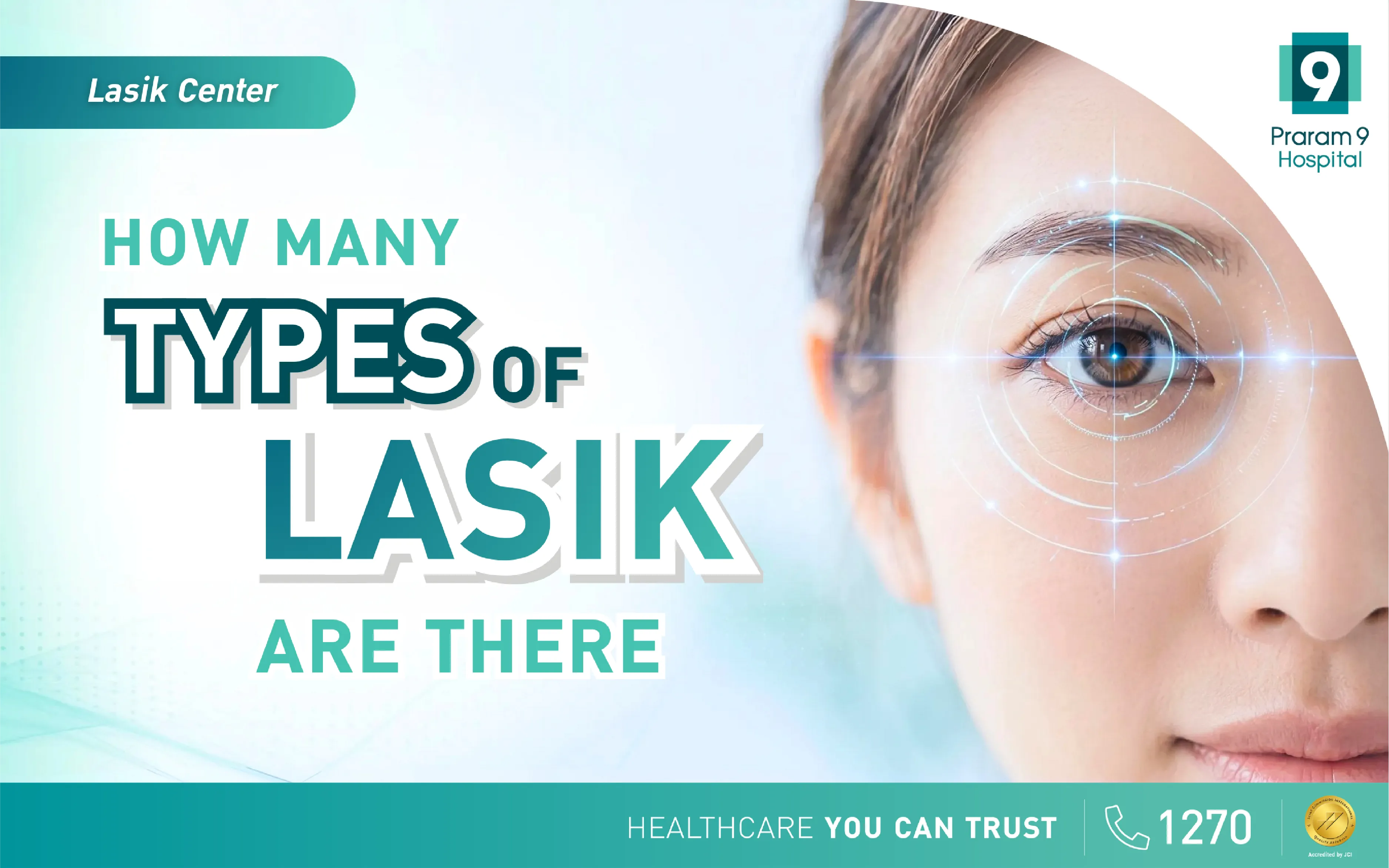
LASIK is a method for correcting vision, including nearsightedness, farsightedness, and astigmatism, with several technology options available.
Types of LASIK
LASIK at present can be divided into 5 main types: PRK, LASIK, FemtoLASIK, SMILE Pro, and PRESBYOND. Each type is suitable for different eye conditions and lifestyles, as follows:
1. PRK (Photorefractive Keratectomy)
PRK (Photorefractive Keratectomy) is the earliest vision correction method, but it is still popular today. The treatment procedure does not separate the corneal layers, but instead removes the outermost corneal layer (Epithelium) first, then uses an Excimer laser to adjust the curvature of the cornea. After that, the cornea is covered with contact lenses for 5–7 days to reduce eye irritation. The surgery duration is approximately 15–20 minutes.
Highlights
- Corrects refractive errors in cases of nearsightedness not exceeding -600, farsightedness not exceeding -500, and astigmatism not exceeding -600
- No anesthesia injection is required, only anesthetic eye drops
- No stitches are required
- Used to treat patients with thin corneas who cannot undergo corneal flap separation treatment
- Causes less dry eye than LASIK methods
Limitations
- There is a chance of corneal haze if exposed to sunlight frequently during the first 2–3 months after the procedure
- May cause more irritation than other methods
- Recovery takes longer than LASIK
Who should undergo this type of LASIK
- People with mild nearsightedness and astigmatism
- People with chronic dry eyes
- People who are required to undergo treatment only with the PRK method, such as preparation for certain profession examinations with risks, such as pilot examinations or military preparatory school examinations
- People who must perform certain activities and sports with risks, such as boxers
- People with limitations for treatment using corneal flap separation techniques
- People with corneal abnormalities, including thin or irregular corneas, history of easy corneal abrasion, history of corneal epithelial detachment, or history of corneal wounds
2. Blade LASIK (LASIK)
Blade LASIK (Microkeratome LASIK, Blade LASIK, or LASIK) is a highly popular technique that uses a small blade to create a corneal flap before using an Excimer laser to reshape the curvature of the cornea to achieve the desired refractive value, then placing the cornea back in its original position. The surgery duration is approximately 15–20 minutes.
Highlights
- Corrects refractive errors in cases of nearsightedness not exceeding -1000, farsightedness not exceeding -500, and astigmatism not exceeding -600
- Patients require little recovery time
- Can return to full visual performance quickly
- Gentle on the eyes, with minimal irritation both during and after surgery
Limitations
- This technique cannot be used for people with thin or irregular corneas
- Corneal surface scars may occur from corneal flap separation (but can heal on their own)
- There is a higher chance of dry eye than other LASIK methods and it is not suitable for patients with chronic dry eyes
Who should undergo this type of LASIK
- People with nearsightedness and astigmatism
- People with sufficient corneal thickness
- People who can open their eyes widely because the instrument size is relatively large
3. FemtoLASIK
FemtoLASIK is a treatment method that uses a Femtosecond Laser in the step of opening the corneal flap. Then, the curvature of the cornea is adjusted using an Excimer laser. It can be said that lasers are mainly used throughout the treatment without using a blade to open the corneal flap (Bladeless LASIK), therefore providing better precision and safety than blade LASIK. The surgery duration is 30 minutes.
Highlights
- Corrects refractive errors in cases of nearsightedness not exceeding -1000, farsightedness not exceeding -500, and astigmatism not exceeding -600
- Low side effects and complications
- Gentle and causes little irritation
- No anesthesia injection is required, only anesthetic eye drops
- Fast recovery because no surgical cutting is required
- Can return to full visual performance quickly
- High precision in corneal flap separation
Limitations
- Corneal scars may occur
- If severe eye trauma occurs, there is still a chance that the corneal flap may shift
- Causes more dry eye than the SMILE Pro method
Who should undergo this type of LASIK
- People with thin corneas
- People with small eyes that cannot be opened widely
4. Small Incision Lenticule Extraction (SMILE Pro)
This is an advanced laser vision correction innovation for nearsightedness and astigmatism from ZEISS, further developed from ReLEx SMILE. It uses the VisuMax 800 machine, which is faster (8–10 seconds), to separate the corneal layer into a thin sheet (Lenticule) and remove it through a small incision of 2–4 mm. No corneal flap is required, reducing dry eyes, allowing wounds to heal quickly, and providing high precision.
Highlights
- No corneal flap separation, therefore there are no complications from the corneal flap
- Very little or almost no irritation or eye pain
- Very little dry eye and reduced night glare
- Preserves the physical structure and strength of the corneal tissue well
- Short surgery duration, laser application only 8–10 seconds
- Has systems to assist with laser center point and axis alignment focus (OcuLign and CentraLign), increasing precision
Limitations
- Requires special physician expertise and skill
- Recovery period is similar to or may be slower than blade LASIK
Who should undergo this type of LASIK
- People who want vision correction without a corneal flap
- People at risk of eye impact or who regularly play sports
- People with dry eyes or who regularly drive at night
5. LASIK for Presbyopia Correction (PRESBYOND)
This is the latest LASIK technology from Zeiss designed to manage presbyopia, suitable for people aged over 40 years. The working principles are as follows:
- Adjusts the refractive value so that one eye focuses on distance vision and the other eye focuses on near vision
- The brain combines the images from both eyes into one image (Blended Vision), allowing clear continuous vision at near, intermediate, and far distances
PRESBYOND presbyopia LASIK therefore not only corrects presbyopia, but also corrects nearsightedness and astigmatism. However, the limitation of this type of presbyopia LASIK is that refractive values may change with age in the future, making it possible to need presbyopia glasses again.
Highlights
- Reduces dependence on reading glasses
- Continuous vision at all distances without image jumping
- Easier adaptation than regular Monovision methods
Limitations
- Overall vision may not be 100% as sharp at a certain distance compared with correcting one distance at a time. Glasses may still be needed in some situations, such as night driving
- A detailed eye suitability examination with an ophthalmologist is required
Who should undergo this type of LASIK
- People with nearsightedness, farsightedness, astigmatism, and presbyopia together
- People who want to reduce dependence on reading glasses
Comparison of Different LASIK Methods
Cost
- Economical: PRK / LASIK
- Moderate: FemtoLASIK
- High: SMILE Pro / PRESBYOND
Recovery
- Fastest: SMILE Pro
- Moderately fast: Blade LASIK and FemtoLASIK
- Slowest: PRK
Chance of Irritation
- Lowest chance of irritation: SMILE Pro (2–4 mm incision)
- Second lowest chance of irritation: FemtoLASIK (20 mm incision)
- Moderate chance of irritation: Blade LASIK (20 mm incision)
- High chance of irritation: PRK (approximately 30 sq. mm wound)
Dry Eye After Procedure
- Lowest: SMILE Pro
- Low: PRK
- Moderate: FemtoLASIK / LASIK
Occupation and Lifestyle
- Occupations, sports, or activities at risk of impact: PRK / SMILE Pro
Summary: Which Type of LASIK Should You Choose?
There is no single LASIK method that is the best for everyone, but there is a “method that is most suitable for each person’s eye condition.”
Each patient must undergo detailed vision measurement and corneal evaluation before deciding to undergo LASIK. Some people can choose from several techniques, while others may be suitable for only certain methods. The most important thing is to undergo examination by a specialized ophthalmologist for a detailed evaluation before making a decision.
For more infomation
- Facebook: Praram 9 Hospital International & Expats
- Line: @praram9lasik
- Tel. 1270
Frequently Asked Questions About LASIK
1. Can LASIK correct presbyopia?
It can be done in some cases with PRESBYOND technology, which is specifically designed to correct presbyopia. This method adjusts the vision of both eyes to work together (Blended Vision) so that near, intermediate, and far vision can all be seen clearly.
2. Who is not suitable for LASIK?
People who may not be suitable for LASIK include those under 18 years old, those whose refractive values are still unstable, people with certain types of thin or irregular corneas, people with certain eye diseases such as keratoconus, glaucoma, or severe dry eye, including those who are pregnant or breastfeeding.
Consideration of suitability requires a detailed examination and evaluation by an ophthalmologist before deciding on treatment.