Health Articles
Knowledge
How many types of robotic knee surgery are there? How are they different?
PRUK CHAIYAKIT, M.D.
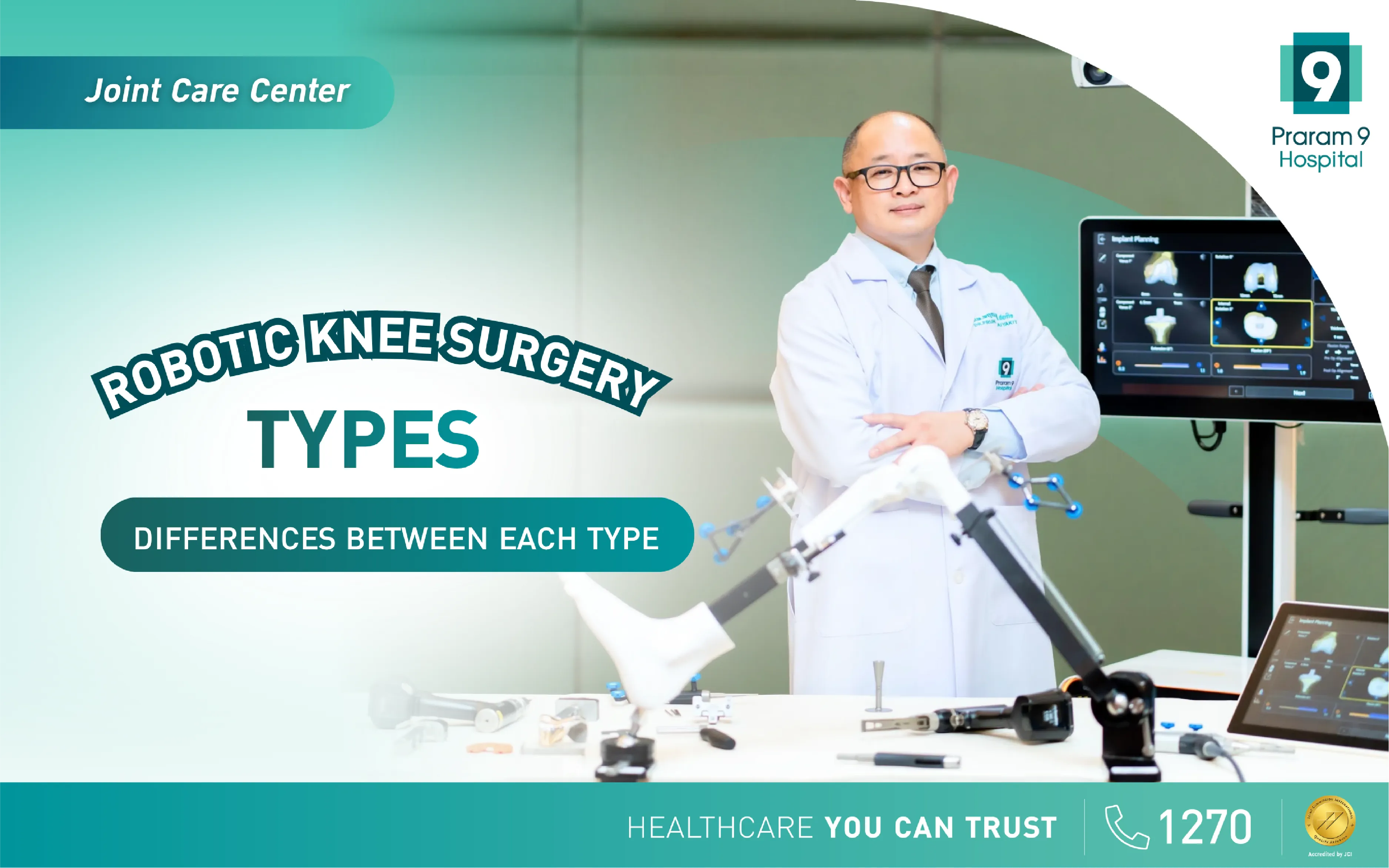
In the present era, it is believed that anyone who is interested in knee replacement surgery must have heard or seen recommendations about the use of robots to assist in knee replacement surgery to some extent. However, there are facts about this matter that many people may still not know.
What are the objectives and advantages of robotic-assisted joint replacement surgery?
The creation of robots to assist in knee replacement surgery aims to help reduce errors in knee surgery, in order to achieve placement of the artificial knee joint in the correct position, with appropriate leg alignment and proper tension of the surrounding soft tissues. These factors themselves will have a positive effect on the longevity and functional performance of the knee joint. Surgical errors may occur at multiple steps as follows:
- Incorrect or deviated targeting of the bone cutting position
- Correct targeting of the bone cutting position, but inability to place the cutting guide device in an appropriate position
- Correct targeting and placement of the device, but inability to cut the bone as intended due to limitations of the device such as loose cutting slots, excessively hard or soft bone, or error from the operating surgeon
- Good bone cutting, but error in adjusting the tension of the ligaments around the prosthetic joint, resulting in imbalance of tension around the joint
- Good bone cutting and good adjustment of ligament tension, but inability to fix the prosthetic joint in the desired position
- As bone cutting uses a saw, there may be deviation causing unintended damage to surrounding tissues, which may be harmful to the patient
Types of robotic-assisted surgery
It can be seen that knee replacement surgery has multiple steps where errors may occur. Therefore, engineers and medical technology specialists have developed robotic-assisted surgical systems to help reduce these errors as much as possible. Each robotic model is designed with different capabilities, ranging from systems that assist only certain steps of the surgery to systems that can assist in controlling nearly all steps comprehensively. At present, in Thailand, there are at least 3 main types of robotic-assisted knee replacement systems in use, which differ according to the level of technology and system complexity, as follows:
1. Robots assisting in positioning bone cutting instruments
This type of robot assists the surgeon only in the steps of “targeting the bone cutting alignment” and “placing the cutting guide device” accurately, reducing problems arising from errors in steps 1) and 2) above.
As for the steps of bone cutting, ligament tension adjustment, and prosthesis implantation, these remain entirely the responsibility of the surgeon using conventional methods.
2. Robots assisting in bone cutting
This is a more advanced robotic system. In addition to assisting in targeting the cutting alignment, it also assists in performing bone cutting according to the planned surgical plan. This system also includes tools to help assess and adjust ligament tension around the joint, as well as to verify prosthesis positioning.
This type of robot can address almost all steps, from step 1) to step 5), but it still cannot automatically prevent injury to surrounding tissues (step 6). Therefore, it still requires the surgeon’s expertise to control the procedure.
3. Fully integrated robotic-assisted surgery
This is a robotic system that operates across all steps of the surgery, from targeting the cutting alignment, performing bone cutting, adjusting ligament balance, to accurately implanting the prosthesis. It includes a safety system that prevents the cutting tool from contacting unintended tissues, or has boundary setting, and can correct all 6 types of errors.
Within this category, there are two subgroups: robotic systems that require preoperative patient data input by sending the patient for a CT scan beforehand to input the knee structure data into the computer, and another system that does not require a CT scan in advance like the first system, instead using real-time data input provided by the surgeon during the operation.
In summary, robotic-assisted knee replacement systems are designed differently as described, which may result in some differences in surgical outcomes to a greater or lesser extent. For further information, contact the Joint Care Center, Praram 9 Hospital.