Health Articles
Knowledge
What is a CT Scan? How is it different from MRI? What can it diagnose?
SALISA PRADITHBATUGA, MD.
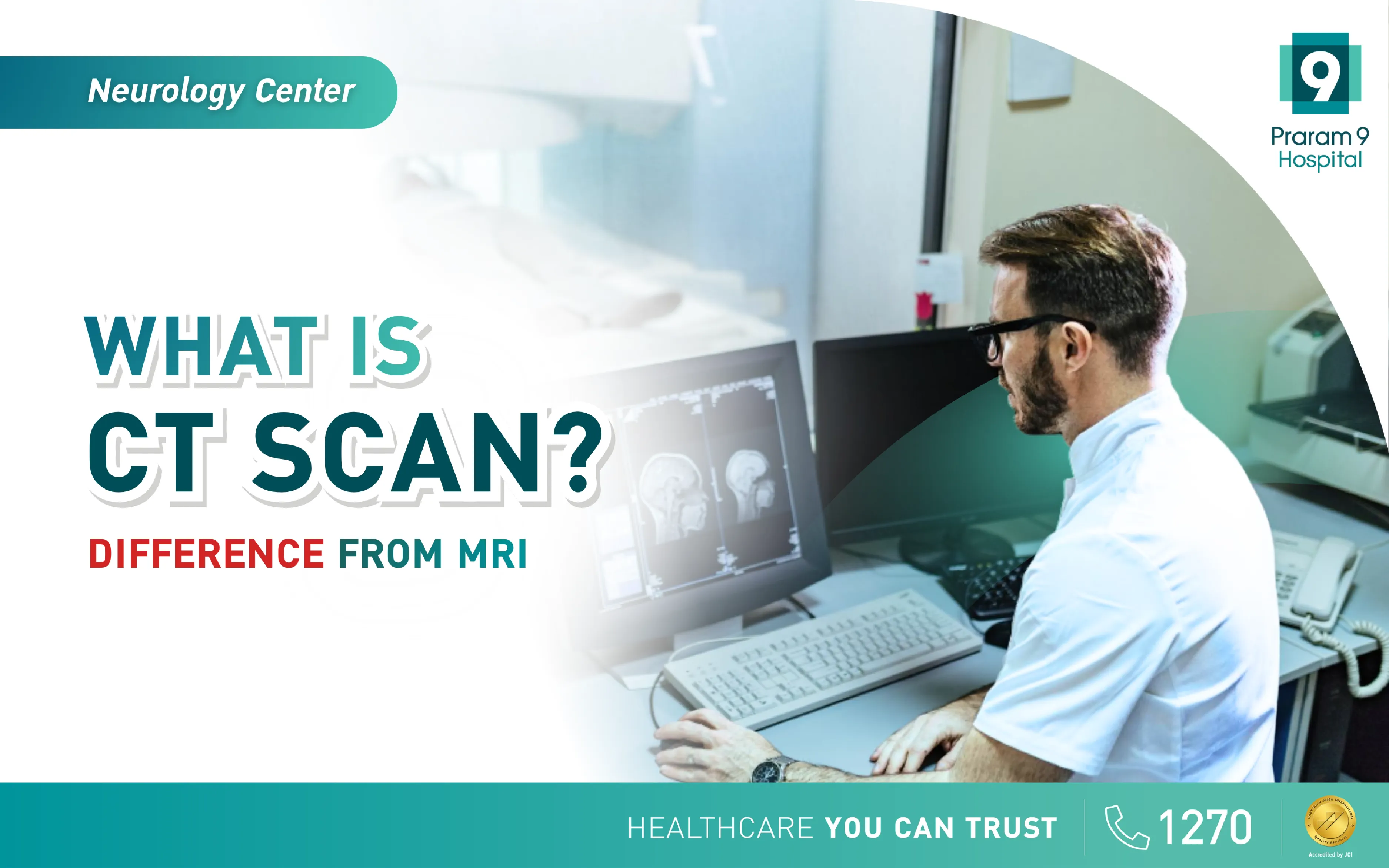
In some cases, disease diagnosis requires the use of medical equipment to assist in diagnosis for greater accuracy. One commonly used technology is the CT Scan, a computerized X-ray tool that can display images of internal organs using a computer system, allowing physicians to clearly see abnormalities.
Get to know what a CT Scan is. Why is it used for diagnosis? How is it different from MRI? All summarized in this article.
Key Takeaways
- CT Scan is a computerized X-ray that provides cross-sectional and 3D images of internal organs, allowing physicians to see abnormalities and diagnose diseases more accurately.
- Images from CT Scan can identify the location of lesions, therefore it can be used to plan surgery or other procedures to reduce the burden on patients after surgery.
- The radiation received from CT Scan is higher than general X-ray, and contrast agents may be toxic to the kidneys. Therefore, before undergoing the examination, a physician should be consulted to understand potential risks.
- How is MRI different from CT Scan? CT Scan uses X-rays for imaging, while MRI uses magnetic fields and radio waves. The results make MRI more detailed and accurate.
What is a CT Scan?
Computerized Tomography Scan or CT Scan is a medical tool that uses X-rays to capture images, then processes them with a computer system to create cross-sectional images before reconstructing them into 3D images. This allows physicians to see internal organs more clearly than general X-rays and can also be used to examine multiple body systems, enabling more accurate diagnosis.
The CT Scan machine has the appearance of a large tunnel with a bed in the center. When operating, the bed moves the patient into the tunnel. Then the X-ray tube rotates around the patient, and the X-rays that pass through the body are detected by sensors on the opposite side.
Conventional CT Scan
This type of CT Scan works by rotating the X-ray tube around the patient, where one rotation produces one image. Then the bed moves to change position before the X-ray tube rotates again. This process continues until cross-sectional images of the organ to be examined are obtained. Conventional CT Scan is an older technology, takes relatively long examination time, and has a higher chance of blurred images because the patient must remain still for a long time.
Spiral / Helical CT Scan
This type of CT Scan works by continuously rotating the X-ray tube around the patient, producing many images to create cross-sectional and 3D images that are sharper and faster than Conventional CT Scan.
What are the advantages of CT Scan? Why has it become a basic diagnostic tool?
At present, there are medical technologies that help physicians diagnose diseases and plan treatment accurately. CT Scan is one of the tools commonly chosen by physicians due to the following advantages:
- Physicians can clearly see abnormalities of internal organs, whether in cross-sectional images or 3D images showing exact locations, without causing pain to the patient.
- What can CT Scan detect? The CT Scan machine can diagnose almost all body systems, including the cardiovascular system, digestive system, brain system, musculoskeletal system, bones and joints, etc.
- Physicians commonly use CT Scan to examine tumors and cancers, such as brain tumors and lung cancer. It can also be used to detect internal bleeding, such as coronary vessels and brain hemorrhage.
- Results from CT Scan can be used effectively for surgical planning or other procedures.
- The CT Scan machine provides rapid diagnostic results, taking only about 10–15 minutes.
- Physicians can immediately refer patients for CT Scan diagnosis without requiring advance preparation.
How should one prepare before a CT Scan to obtain the most accurate diagnosis?
If the physician considers that the patient needs diagnosis with a CT Scan, before the examination, the physician will ask preliminary information and prepare the patient as follows:
- Take medical history to determine whether there are underlying diseases. If there are underlying conditions such as kidney disease, heart disease, diabetes, respiratory disease, or pregnancy, it must be immediately reported to the physician and staff.
- The patient signs a consent form for contrast injection and CT Scan diagnosis.
- In cases of abdominal examination, patients may need to fast for at least 4–6 hours or undergo enema before the examination to obtain clear images without interference.
- If the physician requires clearer images or visualization of tissues, blood vessels, and internal organs to accurately assess pathology, contrast media will be administered, which may be in the form of drinking, injection, or rectal administration.
- For pediatric patients, those with anxiety, or claustrophobia, the physician may administer sedatives to allow smooth examination and accurate results.
- Change into clothing provided by staff and remove all accessories before the examination.
- There should be at least one accompanying person.
Self-care after CT Scan
After undergoing CT Scan, staff will have the patient sit and observe symptoms for 15 minutes after receiving contrast media. If there are no abnormalities, the patient can return to normal daily life. The physician will advise drinking plenty of water, at least 1–2 liters within 24 hours after contrast-enhanced CT Scan, to help the body eliminate the contrast agent quickly.
Clearing doubts: How is CT Scan different from MRI?
CT Scan and MRI are both medical tools for diagnosing lesions in internal organs, but they differ in operation and results as follows:
- CT Scan
- Uses X-rays to capture images and processes them with a computer system to produce cross-sectional and 3D images.
- Suitable for diagnosing abnormalities or diseases of bones, providing more effective results than other methods, and can diagnose internal injuries or other abnormalities such as cancer, tumors, coronary artery stenosis, etc.
- Short examination time, only 10–15 minutes.
- Patients need contrast injection to clearly visualize blood vessels and tissues. Side effects of CT Scan contrast include potential kidney toxicity because the contrast contains iodine.
- Patients with magnetic or metallic implants in the body can undergo CT Scan.
- MRI
- Uses magnetic fields and radio waves, then processes images with a computer to produce realistic 3D images with higher clarity and resolution than CT Scan.
- Suitable for diagnosing conditions related to tissues, blood vessels, nerves, spinal cord, brain, and other internal organs that require high detail.
- Longer examination time, approximately 30–90 minutes or longer depending on the area examined.
- Patients do not necessarily need contrast injection; it is used only when necessary. MRI contrast does not contain iodine and is therefore not toxic to the kidneys.
- Not suitable for patients with magnetic or metallic implants in the body.
Get to know what MRI is and why it is another tool commonly used by physicians for diagnosis. Read more at: MRI is
CT Scan is an important assistant for accurate diagnosis and treatment
CT Scan is a medical tool that can provide detailed information of internal organs in the form of cross-sectional and 3D images. Physicians can therefore diagnose and plan treatment accurately without causing pain to the patient during examination, and there is minimal preparation required. Thus, it has become a commonly used diagnostic tool.
Neurology Center and Radiology Center, Praram 9 Hospital, are committed to identifying the causes of diseases with standardized medical tools and technology, so that patients receive accurate treatment and regain a good quality of life.
For more information
- Facebook: Praram 9 Hospital International & Expats
- Line: @Praram9Hospital
- Tel. 1270
Frequently Asked Questions about CT Scan
1. Does CT Scan have limitations?
CT Scan examination also has some disadvantages because it uses a high amount of X-rays and may require patient cooperation. Therefore, it is not suitable for children, (note: compared, MRI is much narrower), patients with respiratory problems who cannot hold their breath, pregnant women, etc.
In addition, individuals with certain health conditions must inform the physician before undergoing CT Scan, such as those with kidney problems, heart disease, or a history of contrast allergy, as there is a higher chance of complications from contrast media than the general population.
2. How accurate is CT scan?
Diagnosis with CT Scan can provide higher resolution images than general X-rays. The images can be seen in 3D and cross-sectional forms, allowing physicians to accurately identify abnormal locations. However, the accuracy of CT Scan also depends on the area examined, the disease being investigated, and preparation before the examination.
References
Computed Tomography (CT). (2022). National Institutes of Health. https://www.nibib.nih.gov/science-education/science-topics/computed-tomography-ct
The American Cancer Society medical and editorial content team. (2015, November 30). CT Scan for Cancer. The American Cancer Society. https://www.cancer.org/cancer/diagnosis-staging/tests/imaging-tests/ct-scan-for-cancer.html