Health Articles
Knowledge
Cerebral Artery Stenosis: A Dangerous Emergency Condition That Requires Immediate Treatment
SALISA PRADITHBATUGA, MD.
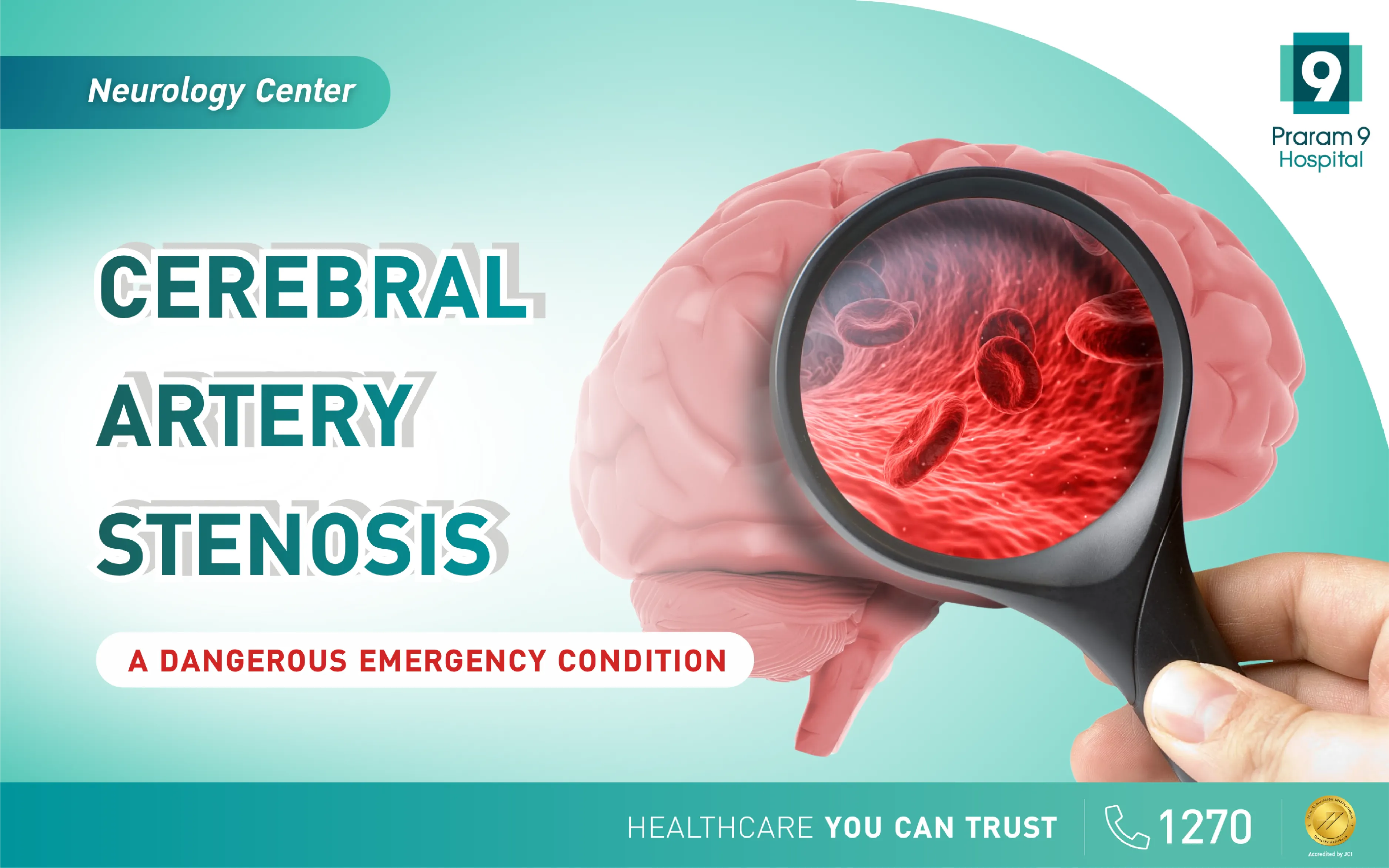
Cerebral artery stenosis is one of the causes of disability and loss of life among people worldwide. Although at present the mortality rate has decreased due to the readiness of medical teams to diagnose and treat in a timely manner, the number of patients with cerebral artery stenosis continues to increase. Therefore, having knowledge and understanding of the causes and symptoms of cerebral artery stenosis will help patients access treatment quickly, increasing the chances of returning to a life that is as close to normal as possible once again.
Key Takeaways
- Cerebral artery stenosis is one of the causes of ischemic stroke, which may cause permanent brain cell damage and the inability to function again if not treated in a timely manner.
- The formation of plaque (Plaque), fatty deposits along the blood vessel walls, and the formation of blood clots are important causes and factors of cerebral artery stenosis.
- Treatment of cerebral artery stenosis focuses on restoring normal blood flow to reduce brain cell damage as much as possible.
- Rehabilitation after receiving treatment for cerebral artery stenosis is important to help patients return to a life close to normal.
What is cerebral artery stenosis?
Cerebral artery stenosis is one of the cerebrovascular diseases, found in approximately 87% of all stroke patients, which can cause disability and death if not treated promptly. This is because the narrowing of cerebral arteries prevents blood from sufficiently supplying brain cells, resulting in damage and eventually leading to the death of brain cells.
Learn about intracerebral hemorrhage, another type of cerebrovascular disease that is less common but more severe than cerebral artery stenosis, which is life-threatening if not treated correctly and promptly: intracerebral hemorrhage
What are the causes of cerebral artery stenosis?
Cerebral artery stenosis is caused by the narrowing or blockage of cerebral blood vessels, which prevents normal blood circulation, leading to ischemic stroke. If not corrected within 4.5 hours, brain cells will be permanently damaged and may cause disability such as paresis, paralysis, or eventually death.
The causes of cerebral artery stenosis can occur as follows:
- Caused by the accumulation of plaque, fatty deposits along the blood vessel walls, leading to narrowing and hardening of the vessels, resulting in slower blood flow in that area and increasing the risk of clot formation.
- Caused by fragments of fat or blood clots that dislodge from other parts of the body and block cerebral blood vessels, causing obstruction of blood flow.
Symptoms of cerebral artery stenosis that must be known
Symptoms of cerebral artery stenosis can occur suddenly. Each patient will present symptoms in different forms depending on physical condition and the area of the lesion. Warning signs of cerebral artery stenosis may include the following symptoms:
- Paresis, paralysis, weakness on one side of the body
- Difficulty speaking or loss of ability to communicate
- Sensory impairment
- Loss of balance
- Loss of vision
- Severe sudden headache
- Dizziness, confusion
- Memory loss, cognitive decline
- Mood changes
If a patient is found to have these symptoms, they should be taken to the hospital immediately for diagnosis and treatment as soon as possible.
Risk factors that may cause cerebral artery stenosis
Cerebral artery stenosis can occur from several risk factors as follows:
- Hyperlipidemia: increases the likelihood of plaque accumulation along blood vessel walls
- Diabetes mellitus: high blood sugar may cause inflammation, hardening, and narrowing of blood vessels
- Heart disease: increases the risk of clot formation and embolization to cerebral vessels
- Hypertension: prolonged high blood pressure causes vessels to become fragile and narrow due to faster-than-normal hardening
- Advancing age: blood vessels may deteriorate with age
- Genetics: individuals with a family history of cerebral artery stenosis have a higher risk
The occurrence of these risk factors is often due to inappropriate health behaviors, for example, overweight, smoking, alcohol consumption, lack of exercise, consumption of foods high in starch, sugar, and fat, stress, etc.
Treatment of cerebral artery stenosis
Treatment of cerebral artery stenosis focuses primarily on correcting blood flow to reduce the impact of permanent brain cell damage. The treatment approaches are as follows:
Thrombolytic therapy
When the patient arrives at the hospital within 4.5 hours after symptom onset and is diagnosed by CT scan or MRI as having cerebral artery stenosis, the physician will administer intravenous thrombolytic drugs. However, the patient must not have contraindications to thrombolytic therapy, such as intracerebral hemorrhage, abnormal bleeding conditions, uncontrolled hypertension, recent head injury or recent cranial surgery, etc.
Mechanical thrombectomy
Mechanical removal of the blood clot that causes cerebral artery stenosis is a treatment method used in cases of large vessel occlusion and when thrombolytic drugs cannot completely remove the clot, including patients who have had symptoms of cerebral artery stenosis for more than 4.5 hours but not exceeding 8 hours. This can be performed by inserting a catheter through a large artery in the groin up to the blocked vessel in the brain to retrieve the clot.
Physical therapy
Patients with cerebral artery stenosis often have effects from brain cells deprived of blood. After receiving treatment to remove the clot, they must undergo rehabilitation so that the body can return to functioning as close to normal as possible. The physical therapy plan depends on the abnormalities that occur, such as speech therapy, movement therapy, swallowing therapy, including psychological therapy for patients who develop disability, etc.
Cerebral artery stenosis: early recognition and prompt treatment increase the chance of recovery close to normal
Cerebral artery stenosis often occurs suddenly and can change a patient’s life permanently without warning. Recognizing warning signs and receiving correct and prompt treatment will help reduce damage from brain cell ischemia and help patients have the opportunity to recover and return to a life as close to normal as possible.
Neurology Center, Praram 9 Hospital provides diagnostic, treatment, and rehabilitation services for patients with brain and nervous system diseases by specialist physicians, with comprehensive technological equipment and standardized services. We prioritize accurate and rapid diagnosis and treatment so that patients have the opportunity to return to a life as close to normal as possible again.
For more information
Facebook : Praram 9 Hospital International & Expats
Line : @Praram9Hospital
Tel. 1270
Frequently Asked Questions about cerebral artery stenosis
1. What is the difference between cerebral artery stenosis and cerebral hemorrhage?
Cerebral artery stenosis and cerebral hemorrhage are types of cerebrovascular disease. The difference is that cerebral artery stenosis causes the brain to be deprived of blood, whereas cerebral hemorrhage causes blood to leak out and compress brain tissue.
2. How can cerebral artery stenosis be diagnosed?
Diagnosis of cerebral artery stenosis can begin with history taking and physical examination of the patient, followed by additional investigations as appropriate, such as CT scan (computed tomography), MRI (magnetic resonance imaging), and EKG (electrocardiogram).
References
Capirossi, C. Laiso, A. Renieri, L. Capasso, F & Limbucci, N. (2023). Epidemiology, organization, diagnosis and treatment of acute ischemic stroke. European Journal of Radiology Open, 11: 100527. https://doi.org/10.1016/j.ejro.2023.100527
Ischemic Stroke (Clots). (n.d.). American Heart Association. https://www.stroke.org/en/about-stroke/types-of-stroke/ischemic-stroke-clots
Lui F, Hui C, Khan Suheb MZ, et al. Ischemic Stroke. [Updated 2025 Feb 21]. In: StatPearls [Internet]. Treasure Island (FL): StatPearls Publishing; 2025 Jan-. Available from: https://www.ncbi.nlm.nih.gov/books/NBK499997/
สุริยะ ปิยผดุงกิจ. (2563). การรอดชีวิตของผู้ป่วยหลังผ่าตัดภาวะเลือดออกในสมอง แปรตามระยะ Midline Shift ในภาพถ่ายเอ็กซเรย์คอมพิวเตอร์และความสำคัญของ ICU หลังผ่าตัด โรงพยาบาลพระนั่งเกล้า จังหวัดนนทบุรี. วารสารวิชาการสาธารณสุข, 29(4): 660-669. https://thaidj.org/index.php/JHS/article/view/9310/8463