Health Articles
Knowledge
Ischemic Stroke: An Emergency Condition That Must Be Treated Quickly Before Risk of Paralysis
SALISA PRADITHBATUGA, MD.
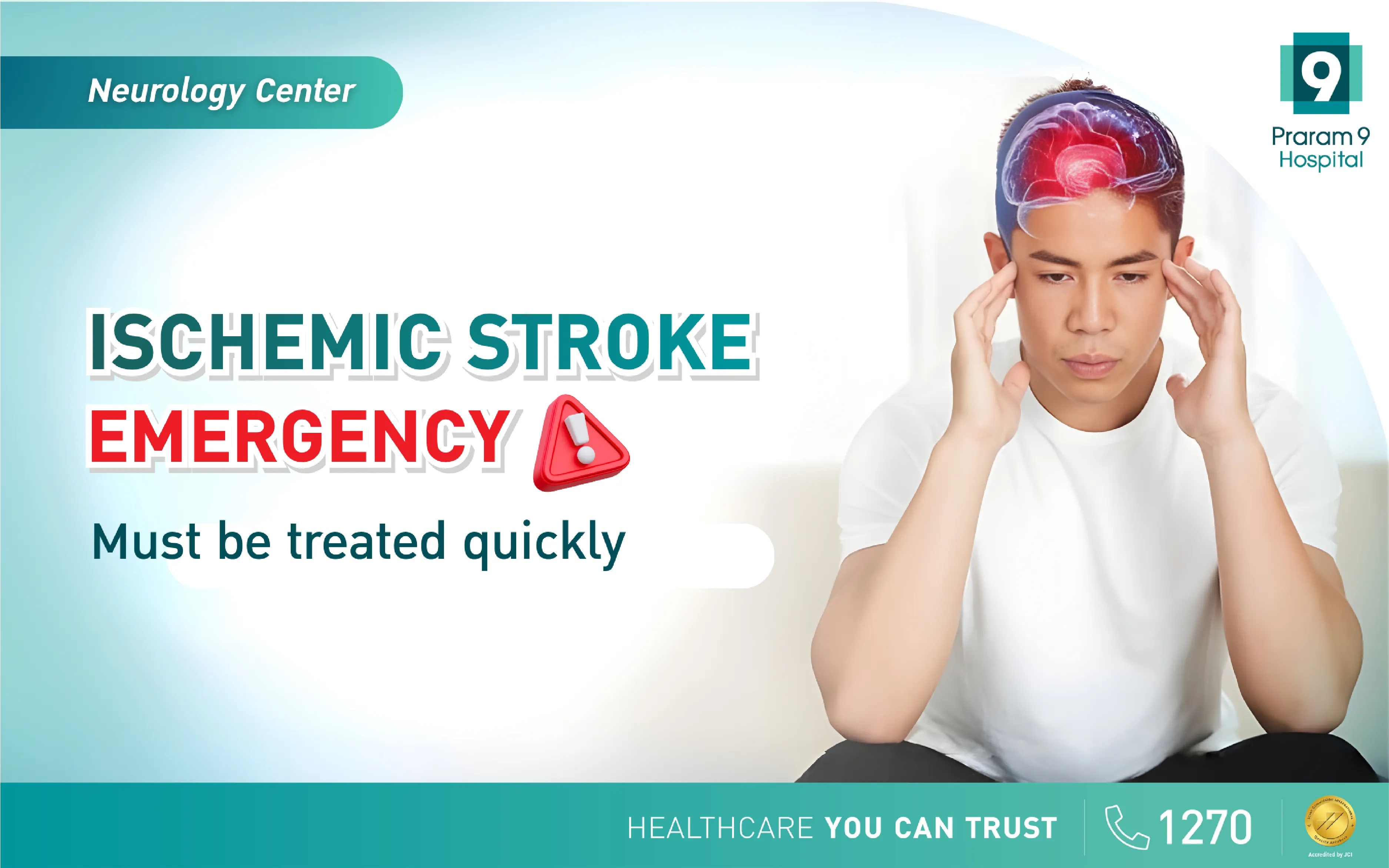
“Ischemic stroke” is one of the abnormalities that, once symptoms occur, can cause disability or death within a short time. Therefore, the period when initial symptoms occur is the golden time during which physicians can provide treatment for the patient to return to a normal life again. Understanding the warning signs of ischemic stroke and quickly bringing the patient to the hospital will help increase the chance that physicians can treat the patient more effectively.
Key Takeaways
- Ischemic stroke is a condition in which the brain does not receive blood supply, causing permanent damage to brain cells, resulting in the affected area no longer being able to function, such as paralysis, stroke, or death.
- Ischemic stroke often occurs suddenly and must be treated immediately to reduce brain damage as much as possible.
- Symptoms that are warning signs of ischemic stroke include weakness of one side of the body, facial drooping, abnormal speech, confusion, numbness on one side of the body, abnormal vision, loss of balance, sudden severe headache, etc.
- Treatment of ischemic stroke can involve thrombolytic drugs, antiplatelet drugs, anticoagulants, lipid-lowering drugs, or surgery to allow blood vessels to deliver blood to the brain again.
What is ischemic stroke?
Ischemic stroke is a condition in which the blood supply to the brain is insufficient, causing the brain to lack blood supply. This results in brain cells not receiving nutrients and oxygen from the blood, eventually leading to the death of brain cells. When brain cells die, the brain can no longer function. The symptoms that occur when brain cells die from ischemic stroke depend on the affected area; most patients often develop neurological symptoms, paralysis, loss of ability to move or communicate. In severe cases, it may cause death.
If ischemic stroke occurs, normally the patient must receive treatment immediately to reduce the chance that brain cells will be deprived of blood and become permanently damaged. However, ischemic stroke may occur only temporarily and can resolve on its own within a few hours and usually does not cause permanent brain damage. This condition is called transient ischemic attack or TIA (Transient Ischemic Attack).
However, TIA is often a warning sign of stroke in the future. If TIA occurs, the patient usually needs close follow-up with a physician.
What causes insufficient blood flow to the brain? What are the causes?
The main cause that leads to ischemic stroke is narrowing of cerebral arteries (Thrombotic Stroke). When blood vessels, which act as channels supplying organs, cannot deliver blood normally, the organ becomes deprived of blood. This is often caused by accumulation of plaque or fat along the vessel walls, gradually narrowing the vessel lumen until the cerebral artery becomes obstructed.
Another case is embolic stroke (Embolic Stroke), caused by a blood clot blocking a cerebral artery and obstructing blood flow. This may be found in patients with arrhythmia or those who have undergone heart surgery.
What are the symptoms and warning signs of ischemic stroke?
When ischemic stroke symptoms begin, brain cells are not yet permanently damaged immediately. If warning signs are recognized and treatment is received quickly, recovery to normal is possible. Symptoms of insufficient cerebral blood flow that are warning signs of ischemic stroke are as follows:
- Weakness or numbness in any part of the body, hemiplegia
- Problems with balance
- Abnormal understanding of speech, slurred speech
- Abnormal vision such as blurred vision, double vision, or loss of vision
- Confusion, dizziness, memory impairment
- Sudden severe headache
Ischemic stroke often presents these symptoms suddenly and takes only a short time to cause permanent damage to brain cells. If these symptoms are found, the patient must be taken to the hospital as quickly as possible.
Risk factors for ischemic stroke
Ischemic stroke is often a consequence of other diseases, which are often caused by inappropriate health behaviors, as follows:
- High blood lipids
Having high levels of blood lipids, especially low-density lipoprotein (LDL), may cause fat to accumulate along vessel walls, leading to narrowing and obstruction.
- Diabetes mellitus
High blood sugar levels can cause inflammation and make blood vessels stiff and narrowed easily, resulting in poor blood circulation.
- Hypertension
High blood pressure makes blood vessel walls fragile and easily damaged, and also increases the risk of cerebral hemorrhage.
These diseases are often caused by being overweight, smoking, alcohol consumption, accumulated stress, and consumption of foods high in starch, sugar, and fat.
Diagnosis of ischemic stroke
Diagnosis of ischemic stroke can be performed by the following methods:
- Taking medical history, underlying diseases, and patient symptoms. If the patient cannot answer, relatives must answer on behalf of the patient.
- Physical examination by the physician to assess neurological and brain function, such as level of consciousness assessment, arm strength testing, blood pressure measurement, etc.
- If risk of ischemic stroke is found, additional tests will be ordered, such as:
- Blood tests
- Computed tomography (CT Scan)
- Magnetic resonance imaging (MRI)
- Electrocardiogram (EKG)
Treatment of ischemic stroke
The treatment approach for ischemic stroke is to restore the ability of blood vessels to deliver blood to the brain normally. Treatment can be done by administering thrombolytic drugs to patients who present with ischemic stroke symptoms within 4.5 hours and who do not have a risk of intracranial hemorrhage.
However, even if the patient cannot arrive within 4.5 hours, it is still recommended to go to the hospital as quickly as possible because the physician may consider performing endovascular procedures to remove the clot obstructing the brain.
Medication treatment: the physician will consider antiplatelet drugs or thrombolytic drugs to prevent vessel obstruction and prevent future clot formation, and lipid-lowering drugs to reduce blood lipid levels and reduce fat accumulation along vessel walls.
In cases of severe narrowing or obstruction of blood vessels, the physician may consider surgery to repair, open, widen the blood flow pathway, or remove obstructions to blood flow.
After emergency treatment, the physician usually provides additional treatment to restore normal body function and prevent recurrence of ischemic stroke, such as physical therapy and treatment of underlying diseases causing ischemic stroke.
Can ischemic stroke be prevented?
Although ischemic stroke symptoms occur suddenly, it can actually be prevented by maintaining good health, which can reduce the risk of dangerous diseases that are factors of ischemic stroke, by the following methods:
- Maintain body weight within normal range
- Exercise regularly and sufficiently
- Eat a balanced diet and avoid foods high in starch, sugar, and fat
- Get adequate rest and manage stress appropriately
- Stop smoking and drinking alcohol
- Annual health check-ups; if diseases are detected early, treatment can be carried out quickly
Ischemic stroke is life-threatening; recognize warning signs to receive timely treatment
Ischemic stroke is a serious threat that may take away a normal way of life, leading to disability or loss of life if not treated correctly and promptly. Knowing and recognizing symptoms that may be warning signs of ischemic stroke will help patients receive treatment quickly and recover to resume daily life as close to normal as possible.
Neurology Center, Praram 9 Hospital, is ready with medical personnel to manage the golden time, allowing patients to receive accurate and rapid diagnosis and treatment, reducing danger from delayed treatment, giving patients the opportunity to recover to normal, and planning prevention of recurrent ischemic stroke in the future.
For more information
Facebook : Praram 9 Hospital International & Expats
Line : @Praram9Hospital
Tel. 1270
Frequently asked questions about ischemic stroke
1. What should be done when ischemic stroke occurs?
Ischemic stroke must be treated by a physician specializing in neurology and the brain. If warning signs of ischemic stroke are found, the patient must be taken to the hospital as quickly as possible to receive appropriate treatment.
2. What complications may occur from ischemic stroke?
Ischemic stroke can cause symptoms or other complications such as paresis, paralysis, memory loss, loss of vision, movement disorders, communication disorders, dysphagia, urinary problems, intracranial hemorrhage, etc.
References
Vega, J. (2024, June 20). Cerebral Ischemia Symptoms and Treatment. Verywell health. https://www.verywellhealth.com/what-is-brain-ischemia-3146480
Hersh, E. (2024, April 11). What Is an Ischemic Stroke and How Do You Identify the Signs? Healthline. https://www.healthline.com/health/stroke/cerebral-ischemia
Stieg, PE. (2024, May). Ischemia, Cerebral. Weill Cornell Medicine. https://neurosurgery.weillcornell.org/condition/ischemia-cerebral
Caldeira, MV. Salazar, IL. Curcio, M. Canzoniero, LMT. & Duarte, CB. (2024). Role of the ubiquitin–proteasome system in brain ischemia: Friend or foe? Progress in Neurobiology. 112: 50-69. https://doi.org/10.1016/j.pneurobio.2013.10.003