Health Articles
Knowledge
What is a dialysis access? Get to know artificial blood vessels for patients with chronic kidney disease
CHALOTHORN TAESILAPASATHIT,M.D.
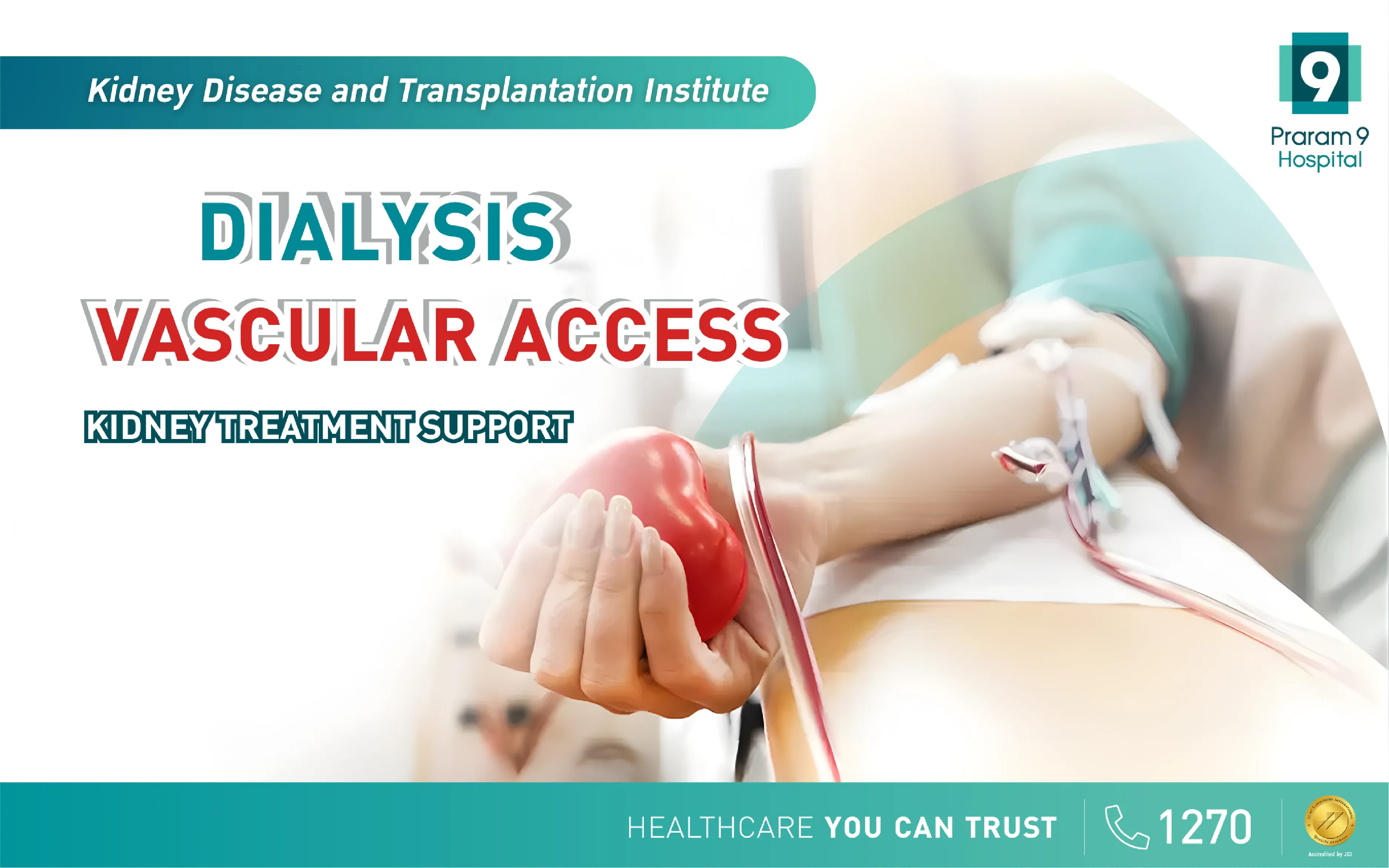
Dialysis is a process that uses a machine to help filter waste from the blood, which normally the ‘kidneys’ perform as the filter, but when the kidneys have problems, the ability to filter waste may deteriorate accordingly. Dialysis access is therefore a blood pathway suitable specifically for dialysis, helping to improve the quality of long-term treatment.
Key Takeaways
- Chronic kidney failure is a condition in which the kidneys permanently lose the ability to filter waste and excess water from the body, causing patients to require continuous treatment such as hemodialysis to help the body excrete waste appropriately.
- Dialysis access is an important blood pathway that allows hemodialysis to be performed conveniently and safely, helping to increase treatment efficiency, reduce the risk of complications, and improve the quality of life for patients with chronic kidney disease.
- Dialysis access is divided into 3 main types: native vessel (AVF), which is strong and durable; artificial vessel (AVG) for those whose vessels are not suitable; and permanent catheter, used in emergency cases or when other types cannot be created.
- Before surgery, patients should undergo vascular examination, strictly control underlying diseases, stop antiplatelet or anticoagulant drugs according to the doctor’s advice, and should exercise arm muscles and blood vessels by squeezing a ball regularly to prepare readiness.
- After surgery, avoid letting the wound get wet or impacted, observe for abnormal symptoms such as swelling, redness, or fever, and exercise the hand and arm to help expand the blood vessels, including avoiding blood draws or blood pressure measurement on the operated arm.
What is chronic kidney failure, kidney degeneration, and when is dialysis required?
Chronic kidney failure, commonly called kidney degeneration, is a condition in which the kidneys gradually lose the ability to filter waste from the body, resulting in toxin accumulation and subsequent health problems. This disease is usually gradual, takes many years, and cannot restore the kidneys to be the same as before; it can only maintain symptoms and slow further deterioration.
Dialysis will begin to be considered when the kidneys reach the end stage, where the kidneys can no longer function sufficiently. Patients will be advised to use dialysis access as a connection pathway for hemodialysis to remove waste such as Urea (BUN), which is a necessary option when the condition reaches this point.
What is dialysis access?
Dialysis access in the arm, also called hemodialysis access, is a pathway used to take blood out of the body to the artificial kidney machine to filter waste instead of the kidneys, and then return the cleaned blood back into the body again, commonly referred to as dialysis. It is usually created in the arm and is an important step for end-stage chronic kidney disease patients who require continuous dialysis.
What types of dialysis access are there?
Dialysis access is equipment that must be well cared for in order to extend its service life. There are 3 main types of dialysis access recommended to be used in order if possible: AVF, AVG, and permanent catheter.
Then how are AVF and AVG different, and why are they ranked later? The differences of each type are as follows:
Native vessel dialysis access (Arteriovenous Fistula: AVF)
Native vessel dialysis access (AVF) is the most commonly used method by physicians for chronic kidney failure patients requiring long-term dialysis. It is a surgical creation of dialysis access by directly connecting an artery and a vein in the arm, such as at the wrist or elbow, causing the vein to receive pressure from the artery, resulting in enlargement and strengthening to support repeated needle insertion during dialysis.
Advantages
- Strong and durable; when the vessel is fully matured, it can be used for 5–10 years or more, depending on care.
- Lower risk of infection because there is no artificial material or foreign body in the body.
- Lower chance of blockage compared to other types.
- After surgery, if there are no complications, the patient can go home immediately.
Limitations
- Requires time for the vessel to mature, approximately 2–3 months, or in some cases the doctor may recommend waiting longer for maximum efficiency.
- Not suitable for those with small or insufficiently strong vessels; evaluation is required before creation. If it cannot be done, artificial vessel may need to be considered instead.
Artificial vessel dialysis access (Arteriovenous Graft: AVG)
Artificial vessel dialysis access (AVG) is an option for those who cannot undergo AVF due to vessels being too small or unsuitable. The doctor will surgically implant an artificial vessel (a special type of plastic tube) connecting an artery and a vein, functioning as a bridge to carry blood to the dialysis machine.
Advantages
- Can be used sooner than AVF, generally within 2–3 weeks after surgery.
- A suitable option for those who cannot have a native vessel created.
Limitations
- Shorter lifespan than AVF, generally about 1–3 years.
- Higher risk of infection and vessel stenosis because artificial material is implanted in the body.
Higher cost of surgery and maintenance than AVF.
Permanent catheter is a method of inserting a special type of plastic tube into a large vein in the neck or chest. One end of the tube remains inside the vessel, while the other end remains outside the body, used as a channel to connect to the dialysis machine.
Suitable for patients who cannot have arm dialysis access, such as those with vessel stenosis or those who require urgent dialysis while waiting for permanent access creation.
Advantages
- Can be used immediately after insertion, no waiting time like AVF or AVG.
- Helps patients in emergency or urgent situations without permanent access.
- Suitable for those with limitations of arm vessels, such as small vessels, stenosis, or multiple prior surgeries.
Limitations
- There is a tube protruding outside the body; strict hygiene care of the tube and skin area is required to prevent infection.
- Higher risk of infection and blockage than other types.
- Shorter lifespan, generally used for medium to short term depending on care.
- Not suitable for long-term use; if the patient can have permanent access, the doctor will consider switching to AVF or AVG in the future.
What are the benefits of dialysis access?
Dialysis access is essential for chronic kidney failure patients who require regular hemodialysis because it prepares a blood pathway to connect with the artificial kidney machine, allowing efficient removal of waste, excess water, and toxins from the body, reducing the chance of acute kidney failure, reducing vascular damage from repeated needle punctures over the long term, making dialysis smoother, and improving the patient’s quality of life even with long-term dialysis.
How to prepare before dialysis access creation?
Preparation before dialysis access surgery is an important step that helps reduce risks during surgery and increases the chance of effective use. The preparation guidelines are as follows:
- Physical examination and ultrasound to assess vascular readiness before surgery.
- Control underlying diseases such as diabetes and hypertension to be stable by taking medications regularly to prevent complications.
- If taking antiplatelet or anticoagulant drugs, consult a doctor about stopping them before surgery.
- Do not remove the pen markings made by the doctor on the arm.
- Avoid blood draws or blood pressure measurement on the arm that will undergo surgery.
- Exercise the vessels by squeezing and releasing a ball for 10–15 minutes each time to strengthen the vessels.
- No need to refrain from food or water unless specifically instructed by the doctor.
What are the steps of dialysis access creation?
After preparation is complete, knowing the steps in advance can help reduce anxiety or stress. The steps are as follows:
- Clean the surgical arm area thoroughly.
- Inject local anesthesia to numb sensation during surgery.
- Make a small incision approximately 3 centimeters at the wrist or elbow crease.
- Locate and connect the artery and vein to increase blood flow.
- The vein will enlarge to serve as a connection pathway to the dialysis machine.
- The surgery takes approximately 1–2 hours.
- If there are no complications, the patient can go home after surgery without hospital admission.
How to care for yourself after dialysis access creation?
After dialysis access creation, proper self-care helps reduce the risk of complications and improves effectiveness of use. The recommended care includes:
- Observe abnormal symptoms such as excessive bleeding, wound swelling, redness, or fever; seek medical attention immediately.
- Take antibiotics as prescribed, especially during the first 7 days, to prevent infection.
- Avoid getting the wound wet for about 7–14 days or until stitches are removed.
- Elevate the operated arm, especially during the first 2–3 days, to reduce accumulation of blood or lymphatic fluid.
- Exercise the arm by squeezing and releasing a small ball about 400 times per day to strengthen the vessels.
- Avoid impact or pressure on the surgical area; do not allow hard or sharp objects to contact the wound.
- Avoid blood draws, blood pressure measurement, or IV fluids on the operated arm to prevent vascular problems.
Dialysis access: a tool that makes kidney disease less frightening
Dialysis access is an important tool that helps chronic kidney failure patients achieve better quality of life because it enables effective dialysis and reduces the risk of complications during dialysis compared to temporary needle puncture.
Currently, there are several types of dialysis access available: native vessel (AVF), artificial vessel (AVG), and permanent catheter. Doctors will consider selecting based on each patient’s suitability to ensure safety and the best outcomes.
Although dialysis may seem significant, with current medical advances, treatment has become easier. At the Kidney Institute, Praram 9 Hospital, there is readiness to provide services and advice in all aspects by specialist physicians, helping patients return to a near-normal life again.
For more information
- Facebook: Praram 9 Hospital International & Expats
- Line: @Praram9Hospital
- Tel. 1270
Frequently Asked Questions about dialysis access
1. How many years does dialysis access last?
The lifespan varies depending on the type selected and care, as follows:
- Native vessel (AVF): approximately 5–10 years
- Artificial vessel (AVG): approximately 1–3 years
- Permanent catheter: approximately 1–3 years, but with good care may last up to 5 years
2. Is there a long waiting time for dialysis access creation?
The waiting time depends on hospital readiness and urgency of the condition. If the patient requires urgent dialysis, the doctor will consider methods that can be used quickly, such as permanent catheter insertion.
If the patient can wait and has suitable vessels, native vessel (AVF) may be selected, but it requires waiting approximately 6 weeks to 6 months for the vessel to mature before use.
References
About vascular access. (n.d.). American Kidney Fund. https://www.kidneyfund.org/treatments/dialysis/about-vascular-access
Lok, C. E., Yuo, T., & Lee, T. (2025, February). Hemodialysis Vascular Access: Core Curriculum 2025. American journal of kidney diseases : the official journal of the National Kidney Foundation, 85(2), 236–252. https://doi.org/10.1053/j.ajkd.2024.05.021
Santoro, D., Buemi, M., Grassi, M., Curto, G., & et al. (2014 Jul 14). Vascular access for hemodialysis: current perspectives. International journal of nephrology and renovascular disease, 7, 281–294. https://doi.org/10.2147/IJNRD.S46643
About the Author