Health Articles
Knowledge
Brain Tumor: Recognizing Headache Symptoms That May Indicate Risk of a Tumor
SITTHI PETCHRUTCHATACHART,M.D.
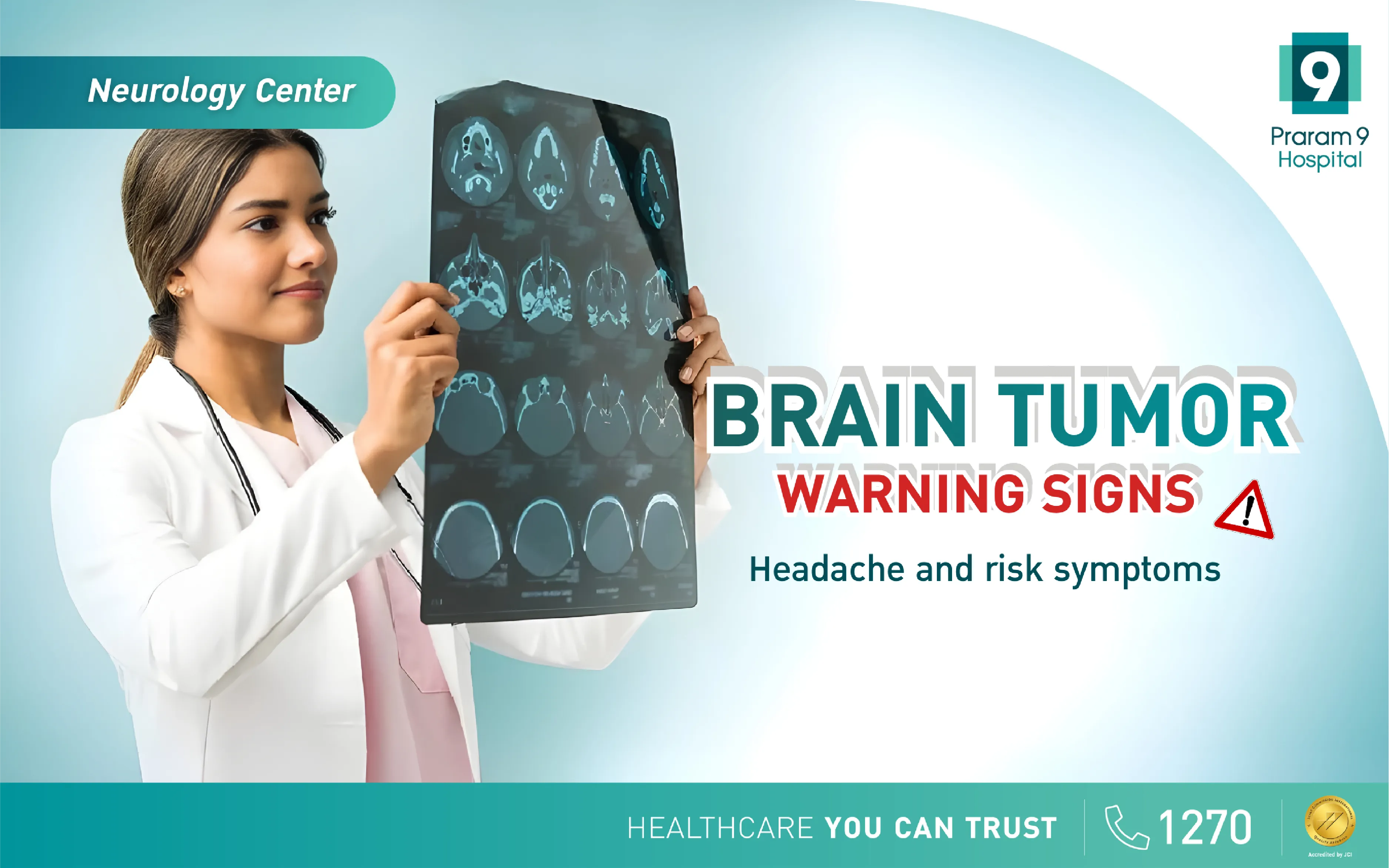
The brain is an important organ that controls all functions of the body’s internal systems. The occurrence of a brain tumor, although it sounds frightening, does not always mean it is life-threatening. Brain tumors have many types, both malignant and non-malignant. If you observe that you or a family member has symptoms that may indicate a risk of having a brain tumor, you should consult a physician for diagnosis and receive appropriate treatment.
Key Takeaways
- Brain tumor (Brain Tumor) is a condition in which a mass in the brain grows abnormally, affecting the functioning of the nervous system and brain
- Tumors found in the brain are not always cancer
- Risk symptoms of brain tumor include chronic headache, vomiting, blurred vision, or weakness of the limbs, etc.
- Treatment of brain tumors can be done in several ways, including surgery, radiation therapy, and chemotherapy, depending on the location and type of tumor
- Many types of brain tumors can be completely cured if diagnosed early
What is a brain tumor?
Brain tumor (Brain Tumor) is a condition in which a mass in the brain grows abnormally, causing the enlarged tissue to compress the brain tissue and nerves, resulting in abnormal functioning of various body systems, such as unexplained headaches, blurred vision, muscle weakness, limb weakness, etc.
Most brain tumors are often assumed to be brain cancer, but in reality, this is not always the case. Brain tumors can be divided into 2 types as follows:
Brain tumors caused by non-malignant cells
Intracranial tumors caused by abnormal division of non-malignant cells in the nervous system (Benign tumor) are tumors that grow slowly, do not spread to other tissues, and usually do not recur after treatment. However, the growth of this tissue, if left untreated, may compress surrounding brain tissue and cause physical abnormalities. These tumors can occur in many locations in the brain, such as the meninges, cranial nerves, or pituitary gland, etc.
Brain tumors caused by cancer cells
Intracranial tumors caused by cancer cells or malignant tumors (Malignant tumor) are tumors that grow rapidly, spread to other brain tissues, and may recur after treatment. Brain cancer may originate in the brain itself (Primary brain tumor) or spread from cancer in other organs (Metastatic brain tumor).
Intracranial tumors caused by cancer cells, if detected late, are difficult to cure and carry a risk of being life-threatening.
Severity levels of brain tumors
In addition to the types of brain tumors, they can also be classified by severity level, based on the growth characteristics of tumor cells and the likelihood of recurrence after treatment (WHO Classification of CNS Tumors). Each level differs as follows:
- Level 1: A non-malignant tumor. Tumor cells grow slowly, do not spread to other brain tissues, can be completely cured by surgery, and have a low chance of recurrence
- Level 2: A borderline tumor between non-malignant and malignant. It grows slower than levels 3 and 4 but may spread to other brain tissues. Treatment is possible but not completely curative, and recurrence is possible
- Level 3: A malignant tumor. Tumor cells grow rapidly and spread to other brain tissues. Treatment focuses on controlling tumor growth and relieving symptoms, helping to prolong the life of patients with brain tumors for several years
- Level 4: A highly malignant tumor. Tumor cells grow and spread rapidly, making treatment difficult and prognosis poor
What causes brain tumors?
At present, the exact cause of brain tumors is not known. However, medically, several factors have been found that may increase the risk of tumor development as follows:
- Age: Brain cancer can be found in both children and adults, but is more common in the elderly, especially those aged 50 years and above
- Genetics: Genetic abnormalities affect tumor development
- Radiation exposure: Direct exposure to radiation in the head area may increase future risk
- Immunodeficiency: People with weakened immune systems, such as patients with HIV/AIDS or those receiving immunosuppressive drugs, may have increased risk
- Chemical exposure: Exposure to certain chemicals, such as industrial chemicals, may increase risk (not yet confirmed and requires further study)
- Family history: If a family member has a history of brain cancer, it may slightly increase risk
Symptoms commonly found in high-risk groups for brain tumors
In high-risk groups for brain tumors, commonly found abnormalities are as follows:
- Chronic headaches that do not resolve with treatment, of unknown cause, and persist continuously for many months without a completely pain-free period
- Blurred vision, double vision, nausea, vomiting, dizziness
- Weakness of the limbs, poor balance, difficulty walking, slurred speech, or difficulty swallowing
- Personality changes, irritability, incoherent speech or speech that is difficult to understand
- Drowsiness, lack of brightness without known cause
- Seizures or numbness affecting one side of the body or face intermittently
The above symptom groups are only common symptoms found in patients with tumors. However, to ensure and receive timely treatment, one should undergo diagnosis by a neurologist, including history taking, detailed physical examination, and consideration of brain CT scan or MRI to determine the cause of symptoms in detail. In cases where a mass is found in the brain, surgery may be required to obtain a tissue sample for more accurate diagnosis.
Treatment approaches for brain tumors
There are several treatment approaches for brain tumors, depending on symptoms, tumor type, and severity at that time. Generally, there are 3 main treatment methods as follows:
1. Surgery
Surgery is suitable for treating brain tumors located in areas that are easily accessible and do not risk damage to important brain tissue and nerves. The purposes of brain tumor surgery are as follows:
- Surgery to remove the tumor completely
- Surgery to remove as much of the tumor as possible (but may not be all)
- Surgery to obtain part of the tumor for examination
2. Radiation therapy
Radiation therapy is a treatment method that uses radiation technology to eliminate abnormally growing tumor cells. This method helps reduce the risk of damage to surrounding brain cells caused by compression from the tumor. It also allows adjustment of energy intensity to make treatment more effective and precise
3. Antitumor medication
Antitumor drugs or chemotherapy are another treatment method in cases where surgery or radiation therapy cannot completely eliminate the tumor in the brain. Physicians often consider using antitumor drugs in combination with surgery or radiation therapy to achieve maximum treatment effectiveness
Complications that may occur from brain tumors
In addition to general symptoms found in patients with brain tumors, there are complications that may occur as follows:
- Deterioration of sensory functions, slurred speech, reduced sense of smell, decreased hearing, and impaired vision
- Weakness of the limbs leading to hemiplegia
- Patients may develop dementia, memory loss, and begin to forget events in daily life
- Problems with excretion and body movement, leading to complications such as bladder or lung inflammation
Brain tumor: early detection can be cured at Praram 9 Hospital
Brain tumors are a dangerous disease. Although not always cancer, they may affect health and life in the long term. Having knowledge and understanding of the disease, observing abnormal symptoms, and promptly consulting a physician when suspicious symptoms occur are important in enabling early treatment. This can help reduce disability and long-term complications
If you find that you or a family member has symptoms in the risk group for brain tumors, it is recommended to undergo diagnosis at the Neurology Center, Praram 9 Hospital, which has a team of neurologists and neurosurgeons with experience and expertise in treating brain tumors. It is also equipped with diagnostic tools, including magnetic resonance imaging (MRI) and computed tomography (CT scan), as well as modern surgical equipment, making the treatment of brain tumors not complicated and safe
For more information
Frequently Asked Questions about brain tumors
1. What symptoms require urgent medical attention?
If you experience severe headache that is unbearable or chronic headache that persists for a long time, limb weakness, seizures, slurred speech, or facial drooping, it is recommended to see a physician immediately for accurate diagnosis and appropriate treatment
2. Can brain tumors be cured?
Whether brain tumors can be completely cured depends on several factors such as tumor type, severity of symptoms at that time, location, size, and overall health of the patient. In general, if it is a non-malignant tumor located in a position where it can be completely removed, there is a high chance of complete cure and it usually does not recur. However, if it is a severe tumor or cancer, even after surgical removal, it may not be completely curable, but it can help prolong the patient’s life expectancy.
References
Brain tumours. (2023, June 12). NHS. https://www.nhs.uk/conditions/brain-tumours/
Brain Tumors and Brain Cancer. (n.d.). Johns Hopkins Medicine. https://www.hopkinsmedicine.org/health/conditions-and-diseases/brain-tumor
Brain tumour symptoms. (2023, January 19). Cancer Research UK. https://www.cancerresearchuk.org/about-cancer/brain-tumours/symptoms