Health Articles
Knowledge
Do not panic, half of the face drooping is a neurological condition that can be cured
NICHANAN EKPITAKDAMRONG,M.D.
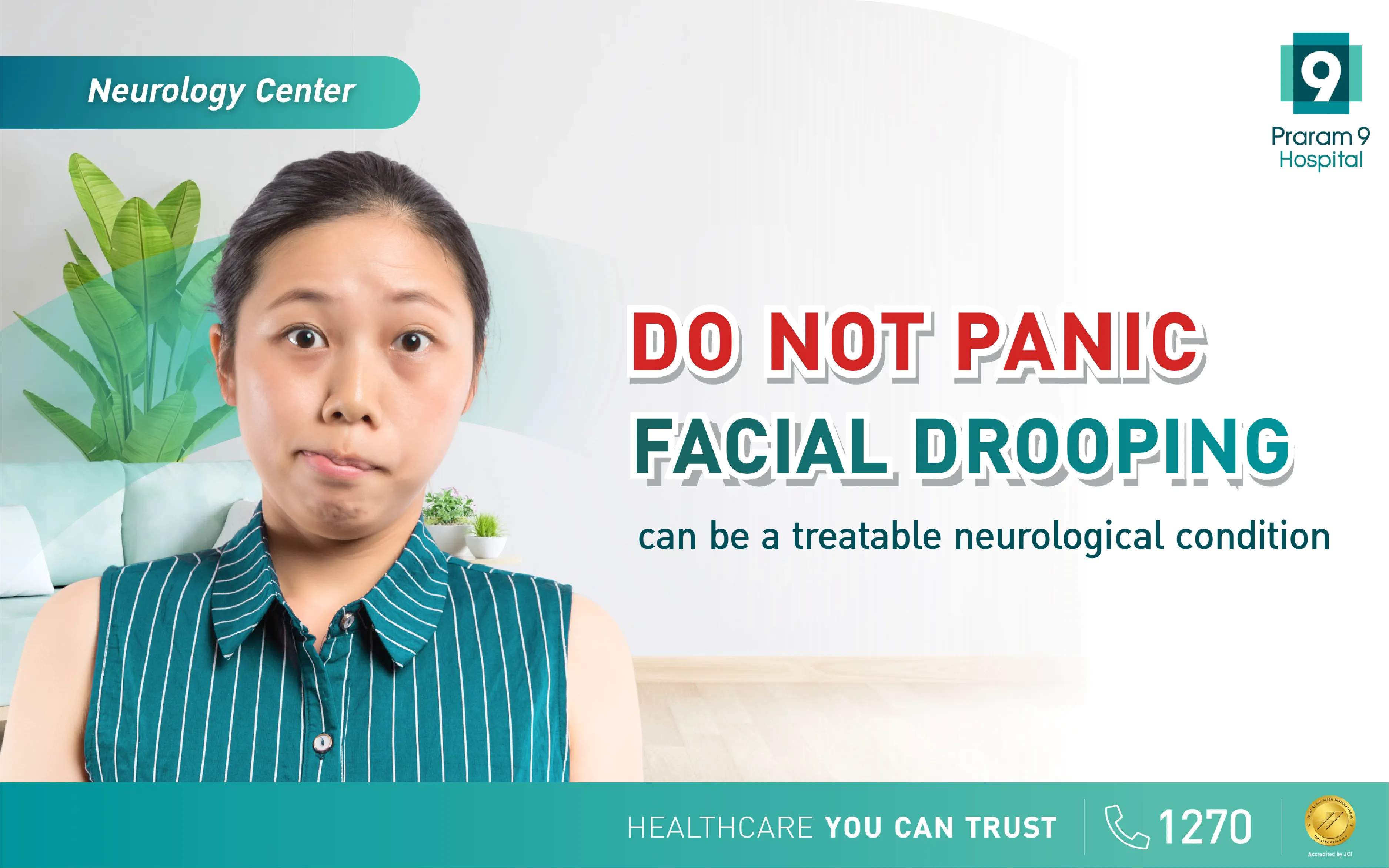
If you have never known information about half-face drooping before and suddenly find that your face is drooping, you would be quite shocked. However, in fact, for half-face drooping (Bell’s Palsy), it is not as frightening as you think. If you see a doctor in time and receive appropriate treatment promptly, you can recover from this condition. In this article, we will introduce everything you should know about half-face drooping, along with answering questions that many people may wonder.
Key Takeaways
- Half-face drooping (Bell’s Palsy) is caused by inflammation of the 7th cranial nerve, resulting in weakness of the muscles on one side of the face or temporary paralysis, but most cases can recover if treated promptly.
- Important symptoms of half-face drooping include inability to fully close the eyes, crooked mouth, unclear speech, drooling, numb tongue, or ear fullness. Symptoms are usually most severe within the first 1–3 days and will gradually improve until fully recovered within 3–6 months.
- Causes and risk groups of half-face drooping are mostly due to viral infections such as herpes, shingles, COVID-19. Risk factors include underlying diseases (diabetes, immunodeficiency), high stress, insufficient rest, pregnancy, etc.
- Treatment of half-face drooping can be done with medication such as steroids, antiviral drugs (when indicated), eye ointment, together with physical therapy to rehabilitate facial muscles.
- Seeing a doctor early will help increase the chance of full recovery and reduce the risk of complications.
What is half-face drooping (Bell’s Palsy)?
Half-face drooping (Bell’s Palsy) is a condition in which the facial muscles become temporarily paralyzed due to inflammation of the 7th cranial nerve that controls the function of facial muscles, causing muscle weakness. Patients cannot move the muscles on one side of the face normally.
What symptoms indicate half-face drooping?
Half-face drooping can occur suddenly. Some patients may experience pain behind the ear, which is a warning sign before symptoms appear, as follows:
- Drooping eyelid, inability to fully close the eyelid, causing dry eyes or eye irritation/inflammation
- Inability to raise the eyebrow
- Crooked mouth, drooping corner of the mouth, unclear speech
- Saliva flowing from the corner of the mouth on the affected side
- There may be numbness of the tongue or loss of taste on the affected side
- Hearing echoing sounds or ear fullness on the affected side
- May feel facial swelling or numbness
- Some cases may have rash or clear blisters around the ear
Symptoms of half-face drooping may be most severe within the first 1–3 days and will gradually improve until recovery within 3–6 months. Only a small number will have permanent symptoms, and recurrence is very rare.
What causes may trigger half-face drooping?
Half-face drooping is caused by inflammation of the 7th cranial nerve. The damage that occurs can be caused by the following reasons:
- Infection is the most common cause found in patients with half-face drooping. Common causative agents include herpes (Herpes Simplex Virus: HSV), shingles (Herpes Zoster Virus), COVID-19 (Coronavirus), etc.
- Injury from accidents
- Weak immune system
Who are at risk of half-face drooping?
Half-face drooping can occur in anyone, all genders, all ages. However, people with certain conditions or the following risk behaviors have a higher chance of developing half-face drooping than the general population:
- People with underlying diseases, especially diseases related to the immune system such as immunodeficiency, autoimmune diseases, diabetes
- People who have experienced accidents or brain concussion
- Pregnant women, especially during the last trimester before delivery and after childbirth, have up to 3 times higher chance than the general population
- People with risk behaviors such as high stress, insufficient rest
How is half-face drooping diagnosed?
When a patient visits a doctor with symptoms of facial drooping, drooping eyelid, drooping mouth corner, the following screening and diagnostic methods are used:
- Medical history taking and physical examination by a doctor
The doctor may ask basic information such as when symptoms started, daily activities, previous illness, and may ask the patient to move facial muscles to observe abnormalities. This information helps the doctor diagnose half-face drooping quite accurately.
- Special examinations
In some cases, the doctor may consider additional tests to confirm the diagnosis such as blood tests, cerebrospinal fluid examination, electromyography (EMG), computed tomography (CT scan), or magnetic resonance imaging (MRI), etc.
How is half-face drooping treated?
Treatment of half-face drooping can be done by reducing symptoms and rehabilitation as follows:
Medication
This is the initial treatment after diagnosis of half-face drooping. The medications prescribed include:
- Steroids to reduce nerve inflammation and help the nerve return to normal function faster
- Eye ointment or eye drops to maintain moisture in the eyes, reduce irritation, and prevent conjunctivitis
- Antiviral drugs, which the doctor will consider in cases where the drooping is caused by herpes or shingles infection
Physical therapy
This is a method to rehabilitate facial muscles to prevent atrophy. It can be done through facial muscle exercises, facial massage, and warm compresses to improve blood circulation, increase strength of facial muscles, and reduce facial tightness. In some severe cases, the doctor may recommend electrical stimulation therapy.
Half-face drooping is not as frightening as you think if treated in time
Although half-face drooping shows alarming symptoms, it is not actually as dangerous as it seems if treated promptly. However, facial drooping may not be caused by half-face drooping alone. Seeing a doctor for a thorough examination is necessary to screen for other potentially dangerous diseases and to ensure appropriate treatment from the beginning.
Neurology Center, Praram 9 Hospital pays attention to every detail in diagnosis, not overlooking even small details, to achieve accurate diagnosis and targeted treatment, enabling patients to recover quickly and return to life with confidence again.
For more information
- Facebook : Praram 9 Hospital International & Expats
- Line : @Praram9Hospital
- Tel. 1270
Frequently asked questions about half-face drooping
1. Is half-face drooping the same as stroke?
Half-face drooping (Bell’s Palsy) and stroke are not the same disease. Half-face drooping is caused by inflammation of the cranial nerve, whereas stroke is a complication caused by cerebrovascular disease that leads to lack of blood supply to the brain. The symptoms of stroke are different, such as weakness in areas other than the face like arms and legs. A clearly different symptom is that stroke patients can fully close their eyes and raise their eyebrows, whereas patients with half-face drooping cannot.
2. How to know if there is facial drooping?
Patients can test to observe facial drooping by:
- Trying to raise both eyebrows
- Closing both eyes
- Smiling widely
If there is facial drooping, the patient will not be able to raise both eyebrows equally, cannot fully close one eye, and cannot smile equally on both sides.
References
Bell’s Palsy. (2023, August 14). Cleveland Clinic. https://my.clevelandclinic.org/health/diseases/5457-bells-palsy
WebMD Editorial Contributor & Walker-Journey, J. (2023, November 14). Bell’s Palsy. WebMD. https://www.webmd.com/brain/understanding-bells-palsy-basics
Hohman MH, Warner MJ, Varacallo MA. Bell Palsy. [Updated 2024 Oct 6]. In: StatPearls [Internet]. Treasure Island (FL): StatPearls Publishing; 2025 Jan-. Available from: https://www.ncbi.nlm.nih.gov/books/NBK482290/