Health Articles
Knowledge
What is a Cath Lab? A laboratory for assisting in the treatment of coronary arteries
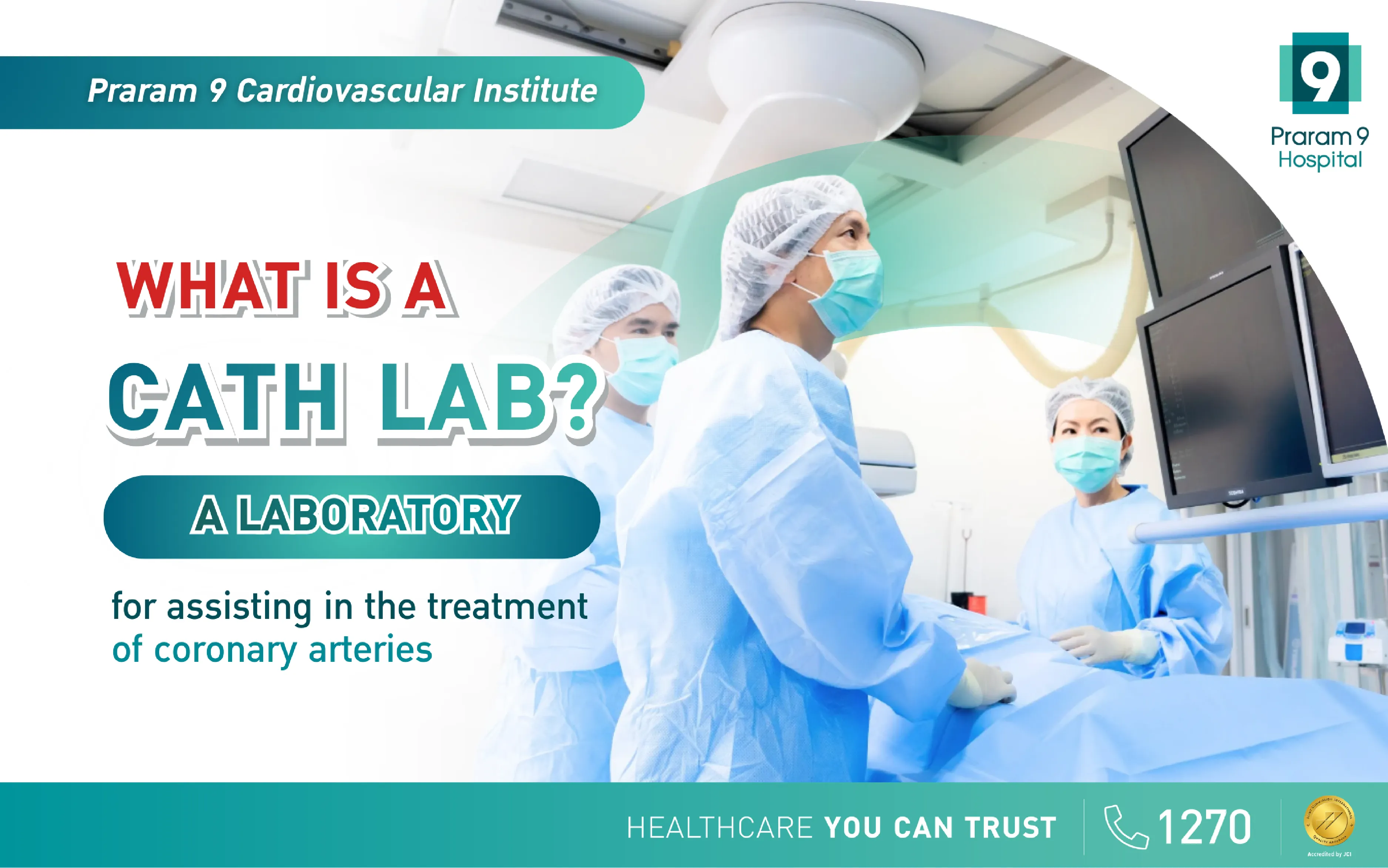
Heart disease remains a major cause of death among Thai people, but now we have technology that helps treatment to be faster and safer, without requiring major surgery. All of this can be done in the “Cath Lab” or cardiac catheterization laboratory at Praram 9 Hospital, which is a specialized area that uses advanced technology to thoroughly detect abnormalities of the coronary arteries. So how are the examination and treatment methods through the Cath Lab? This article has complete answers.
Key Takeaways
- Cath lab is a room for examination and treatment of heart disease using X-ray equipment and modern digital technology for diagnosis and treatment of coronary artery disease without surgery
- The Cath Lab examination procedure is performed through a small cardiac catheter by injecting contrast dye into the blood vessels to view abnormalities of the coronary arteries, taking approximately 20 minutes
- Reduces risks from major surgery, patients recover quickly, have less pain, and can return to normal life in a short period
- Helps doctors diagnose and treat heart disease accurately, along with treatment by balloon dilation or stent placement if abnormalities are found
- Cardiac catheterization is an important option for those with coronary artery disease, especially those who wish to avoid open-chest surgery
What is a Cath Lab and what is it used for?
Cath lab (Cardiac Catheterization Laboratory) is a room for examination and treatment of heart and vascular diseases using X-ray equipment and modern digital technology, using the technique of contrast injection into the vessels (Cardiac Catheterization) so that doctors can clearly see the coronary arteries and perform treatment through a small catheter at the wrist or groin without open-chest surgery
Cardiac catheterization in the Cath lab is often used to find the cause of ischemic heart disease or arterial stenosis, which may cause cerebral ischemia, including preparation before other treatments such as balloon insertion, stent placement, or preparation for heart surgery
When should one undergo a Cath Lab examination? What symptoms should be present
Examination in the Cath lab is an important procedure for those at risk of heart disease or with abnormal heart-related symptoms, especially in cases where coronary arteries are suspected to be narrowed or blocked, resulting in insufficient blood supply to the heart muscle
Those who should undergo Cath Lab examination often have the following symptoms
- Chest pain or tightness or discomfort in the chest continuously for more than 5 minutes
- Unusual easy fatigue even without much exertion
- Those with severe arrhythmia
- Other risk factors such as diabetes, high blood pressure, high blood lipids, acute heart failure, or family history of heart disease
How to take care of yourself before and after a Cath Lab examination
Undergoing a Cath lab examination is a process that requires inserting equipment into the body to assist in accurate diagnosis and treatment planning. Proper preparation and good post-examination care will help the body recover smoothly
Self-care before cardiac catheterization
- Refrain from water and food for approximately 6 hours before the examination to reduce the chance of vomiting during the process
- Undergo preliminary examinations such as blood tests, echocardiogram, chest X-ray, and electrocardiogram to assess physical readiness, which may be performed together with other heart examination methods such as EST
- Bathe and clean the body and change into clean clothing before entering the examination room
- Prepare the groin or wrist area, as it is the insertion site for the catheter; staff will clean and shave that area
- Avoid wearing jewelry or metal and leave valuables with relatives or staff before entering the examination room
Self-care after cardiac catheterization
- Lie still, adjusting the bed so that the head is elevated about 30–45 degrees, use a sandbag to press on the wound area to reduce the risk of bleeding for at least the first 2–4 hours
- Avoid lifting heavy objects or excessive exertion in the initial period; start with light movement or slow walking as advised by the doctor
- Keep the wound dry; wait until the wound is completely dry before bathing. If the wound is not yet dry, clean with alcohol and cover with a plaster
- Drink plenty of water, at least 2,000 cc per day, to help the body excrete contrast material through urine
- Avoid stimulants such as coffee, tea, soft drinks, and refrain from smoking to reduce the workload of the heart
- If there are abnormal symptoms such as chest tightness, difficulty breathing, excessive bleeding at the wound site, or abnormal numbness, inform the doctor or staff immediately
How is the Cath Lab procedure performed?
The Cath lab examination is a coronary artery examination using a special technique that does not require surgery, allowing doctors to diagnose heart disease accurately and quickly. The Cath lab procedure has the following details
- Preparation before starting the examination: the doctor will inject local anesthesia at the groin or wrist, which is the site for catheter insertion. Then a small sterile tube (approximately 2 millimeters) is inserted through the artery into the coronary artery
- Injection of contrast dye into the blood vessels to examine the coronary arteries: after the catheter is in place, the doctor will inject contrast material through the catheter to view images of the coronary arteries via a high-resolution digital X-ray machine, allowing clear visualization of areas where the vessels may be narrowed or blocked
- Concurrent treatment during Cath lab examination (if necessary): if abnormalities such as narrowing of the coronary arteries are found, the doctor may proceed with treatment immediately, such as a. Balloon dilation and stent placement to open narrowed or blocked vessels
b. Pacemaker insertion for patients with bradycardia
c. Ablation for arrhythmia to restore normal heart rhythm
d. Insertion of a catheter to support heart function in critical conditions to help the heart function continuously during treatment
4. Wound closure and post-Cath lab care: when the examination or treatment is completed, the doctor will remove the catheter and use a plaster or sandbag to compress the wound at the insertion site to stop bleeding, which takes approximately 2–4 hours. After that, the patient is allowed to start moving under the supervision of the medical team
What are the benefits of cardiac catheterization?
Cardiac catheterization in the Cath Lab is one of the methods for examining and treating heart disease that helps reduce risks and allows patients to receive timely treatment, especially in acute myocardial infarction where every minute is valuable. With modern technology and a team of specialist cardiologists, along with professional nurses providing care 24 hours a day, the benefits are as follows
- Provides rapid treatment, especially in acute myocardial infarction requiring urgent assistance
- Small wound, less pain, fast recovery; many patients rest for only 1–2 days before returning home
- No need for major surgery; patients do not need open-chest surgery like traditional heart surgery, reducing pain and complications
- Reduces risks from major surgery, as only catheters and specific devices are used, significantly lowering the chance of complications such as infection
- Accurate detection of abnormalities; Cath Lab allows doctors to see real-time images of coronary arteries, enabling immediate diagnosis and treatment when problems are found
- Can be used in combination with other treatments if the doctor considers additional methods such as coronary artery surgery, depending on symptoms and the doctor’s judgment
Cath Lab is an important option for heart disease treatment
Cath lab is one of the important options for those with heart disease problems because it enables doctors to quickly diagnose and treat abnormalities of the coronary arteries without major surgery, reducing recovery time and helping patients return to normal daily life faster
If looking for a heart treatment center for Cath Lab, the Praram 9 Heart and Vascular Institute is an option that should not be overlooked because Praram 9 Hospital provides modern and comprehensive Cath Lab services with a team of cardiologists, nurses, and specialized staff providing care 24 hours a day. If experiencing symptoms such as acute chest pain or abnormal shortness of breath, do not delay, because every second is valuable to life
For more information
Facebook : Praram 9 Hospital International & Expats
Line : @Praram9Hospital
Tel. 1270
Frequently asked questions about cardiac catheterization
1. Why is cardiac catheterization necessary?
Cardiac catheterization through the Cath lab helps doctors check whether the coronary arteries are narrowed or blocked in order to plan appropriate treatment
2. How long does a Cath Lab examination take?
Normally, a Cath Lab cardiac catheterization examination takes approximately 20–30 minutes, depending on the complexity of each patient
References
Cardiac catheterization: Procedure & recovery. (2025, March 4). Cleveland Clinic. https://my.clevelandclinic.org/health/diagnostics/16832-cardiac-catheterization
Catheter labs (2025, February 1). Newcastle Hospitals. https://www.newcastle-hospitals.nhs.uk/services/cardiothoracic-services/cath-lab/
Catheterization laboratories (Cath Lab). (n.d.). Washington Health. https://www.washingtonhealth.com/services/cardiac-services/catheterization-laboratories-cath-lab-/