Health Articles
Knowledge
Stay alert! Chronic coronary artery narrowing, a danger from vascular disease that you must beware of
NATHAPOL KHOW-EAN,M.D.
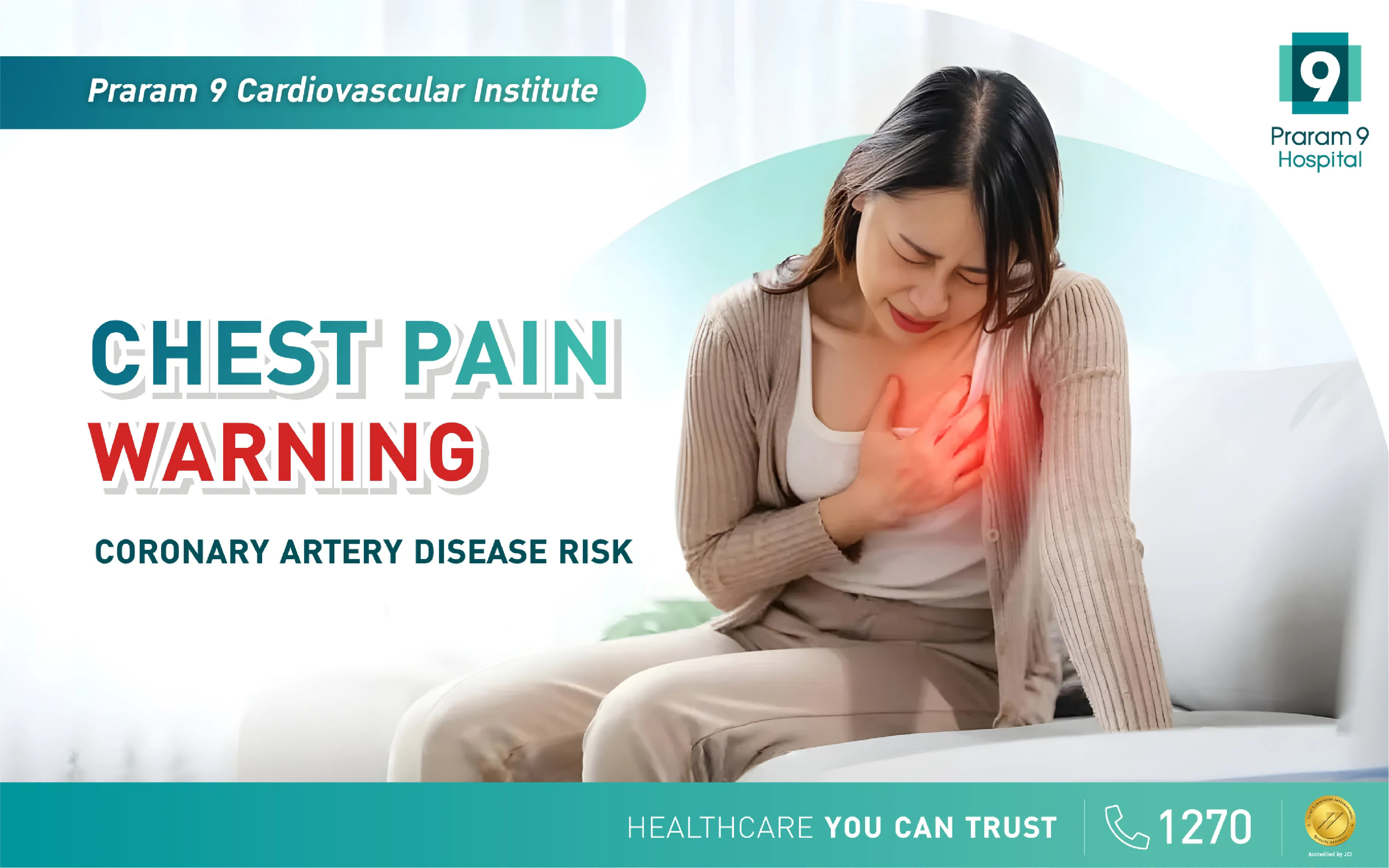
Chronic coronary artery narrowing and various forms of coronary artery disease are conditions that are increasingly found in a concerning manner at present, and are a serious silent threat, because if not treated in a timely manner, they may lead to myocardial infarction or heart failure. Many people may have experienced heart pain or chest tightness, causing concern and prompting them to see a physician to check for coronary artery narrowing to determine whether the symptoms are related to heart disease or not.
This article is supported by information from Dr. Nathapol Khow-Ean, a specialist physician in cardiology at Praram 9 Cardiovascular Institute, who will explain in detail which types of chest pain are suspicious for heart disease and what accurate medical diagnostic methods are available.
Key Takeaways
- Chronic coronary artery narrowing is a condition in which the coronary arteries gradually become narrowed due to plaque or fat, resulting in insufficient blood supply to the heart.
- Symptoms of chronic coronary artery narrowing include heart pain, chest tightness as if something is pressing on it, pain radiating to the jaw or left arm, and exacerbation when easily fatigued or during heavy exertion.
- Risk factors that accelerate the development of chronic coronary artery narrowing include diabetes, hypertension, hyperlipidemia, as well as smoking and obesity.
- Chronic coronary artery narrowing can be diagnosed by EKG and Exercise Stress Test (EST), but coronary angiography (CAG) is the standard method that shows the degree of narrowing more clearly.
What is chronic coronary artery narrowing?
Chronic coronary artery narrowing (Chronic Coronary Syndrome or Stable Angina) is a condition in which the arteries supplying the heart muscle (coronary arteries) gradually and continuously narrow over a long period. When the arteries narrow to a certain level, the heart muscle receives insufficient oxygen, especially when the heart requires more blood. This condition requires regular cardiovascular examinations to assess risk and plan appropriate treatment.
What chest pain symptoms do patients usually consult a cardiologist about?
Often, patients come for consultation with the question, “Having heart pain or chest pain like this, is it a sign of heart disease?” In reality, the heart pain experienced by patients varies. These symptoms may be signs of chronic coronary artery narrowing or may be caused by other conditions not directly related to the heart. Common chest pain symptoms that should be given attention are as follows:
- Heart pain, chest tightness, discomfort, feeling like something heavy is pressing on the center of the chest, which is a characteristic feature of heart pain from coronary artery narrowing.
- Heart pain during exertion or stress, chest pain that occurs or worsens during exercise, brisk walking, or emotional stress.
- Pain radiating to other areas, heart pain radiating to the left arm, jaw, neck, or back.
- Sharp or stabbing heart pain, pain that usually occurs briefly, often not directly related to heart disease, but causes great concern to patients.
- Associated fainting symptoms, chest pain accompanied by palpitations, dizziness, or fainting may be a dangerous sign of chronic coronary artery narrowing.
- Abnormal easy fatigue, patients may present with easy fatigue together with heart pain or intermittent chest tightness.
What causes chronic coronary artery narrowing?
The main cause of chronic coronary artery narrowing is the process of degeneration and inflammation within the coronary arteries, which is a mechanism that occurs within the body itself, including:
- Atherosclerosis, starting from the accumulation of fat, especially LDL, and various cells in the inner lining of the coronary artery walls.
- Plaque formation, increased accumulation leads to plaque forming within the arteries, which progressively narrows the blood flow pathway.
- Chronic vascular inflammation, various risk factors such as diabetes cause continuous inflammation of the vessel walls. This inflammation stimulates plaque to enlarge and harden, which is a direct cause of chest pain.
What are the risk factors for chronic coronary artery narrowing?
It can be seen that chronic coronary artery narrowing does not occur overnight, but is often the result of accumulated damage in the coronary arteries over many years. Important risk factors that accelerate this process are as follows:
- Hyperlipidemia, especially high LDL, is a major cause of plaque formation in arterial walls.
- Hypertension, excessively high blood pressure damages the inner lining of blood vessels, making it easier for fat deposits to accumulate.
- Diabetes, prolonged high blood sugar damages blood vessels throughout the body, including coronary arteries, leading to inflammation and narrowing more easily.
- Smoking, chemicals in cigarettes are highly toxic to blood vessels, causing inflammation and accelerating arterial hardening.
- Genetic factors, having family members, especially first-degree relatives, with early-onset heart disease is an uncontrollable risk factor.
- Stress and lifestyle behaviors, chronic stress, lack of exercise, and inappropriate diet such as high sodium and high fat foods all contribute to fat accumulation and trigger chest pain, making chronic coronary artery narrowing more likely.
How is chest pain from coronary artery disease diagnosed?
For the diagnosis of chronic coronary artery narrowing, physicians begin with a detailed history of symptoms and risk factors, then recommend specific diagnostic tests to differentiate whether the symptoms are caused by coronary artery disease.
These diagnostic tools are important for evaluating chronic and acute conditions to ensure timely treatment.
1. Electrocardiography (EKG)
Electrocardiography (EKG) records the electrical signals of the heart to screen for coronary artery disease at rest. It has high accuracy in diagnosing acute coronary conditions and is often performed together with cardiac enzyme blood tests. However, for chronic coronary artery narrowing, a resting EKG may appear normal, so heart disease cannot be ruled out. Patients often require additional cardiovascular examinations to confirm hidden ischemia.
2. Exercise Stress Test (EST)
EST is a convenient method for evaluating patients with unclear chest pain. The purpose is to increase the heart rate by treadmill exercise while monitoring the electrocardiogram. If there is underlying chronic coronary artery narrowing, the increased heart rate will cause myocardial ischemia, showing abnormalities on the ECG or causing chest tightness. If the EST result is clearly abnormal, the patient will be referred for coronary angiography for confirmation.
3. Coronary Angiography (CAG)
Coronary angiography, or what physicians call “cardiac catheterization,” is the standard for detecting coronary artery narrowing. A catheter is inserted through the wrist or groin, and contrast dye is injected to visualize the degree of blockage in the coronary arteries. When blockage is found, the physician will immediately plan treatment, which may include medication, balloon angioplasty, or referral for coronary artery bypass graft surgery (CABG).
How to prevent chronic coronary artery narrowing?
Effective prevention of chronic coronary artery narrowing involves lifestyle modification and management of controllable risk factors. Consistent and disciplined self-care helps slow vascular degeneration and effectively reduce the risk of heart disease.
- Strictly control underlying diseases, including blood sugar levels, blood pressure, and lipid levels according to physician recommendations.
- Completely stop smoking, as quitting smoking is important for restoring vascular health because cigarette smoke directly damages blood vessels.
- Choose heart-healthy foods, emphasizing high-fiber foods, vegetables, fruits, and whole grains, reducing saturated fat, trans fat, and high-sodium foods, and avoiding sugar and processed foods.
- Exercise regularly, perform moderate-intensity exercise such as brisk walking or swimming for at least 150 minutes per week to help control weight and strengthen the heart.
- Maintain a normal body weight, keep BMI within the range of 18.5–22.9 to reduce the workload on the heart and blood vessels.
- Manage stress and get adequate rest, ensure sufficient sleep and practice appropriate stress management, as chronic stress negatively affects blood pressure and overall health.
Chronic coronary artery narrowing should not be neglected. Be well informed in detail for timely treatment.
Chronic coronary artery narrowing does not occur suddenly but results from long-term vascular deterioration accumulated over many years from various risk factors, including lifestyle and underlying diseases. Therefore, one should always observe bodily symptoms and not ignore abnormal heart pain, as it is a warning signal of danger approaching your heart.
If you suspect that you are in a risk group or want greater confidence from accurate diagnostic results, Praram 9 Heart and Vascular Institute has a team of specialist cardiologists along with a variety of diagnostic tools, ready to plan long-term heart health care so that you can return to living your life fully and confidently again.
For more information
- Facebook: Praram 9 Hospital International & Expats
- Line: @Praram9Hospital
- Tel. 1270
Frequently Asked Questions about chronic coronary artery narrowing
1. What does triple vessel coronary artery disease mean?
It means that all three coronary arteries supplying the heart muscle are simultaneously narrowed or blocked, which is a severe condition indicating complex coronary artery disease.
2. What are the treatment methods for chronic coronary artery disease?
Mainly include medication to control symptoms and risk factors, balloon angioplasty with stent placement, or coronary artery bypass graft surgery (CABG), depending on the severity of the condition.
References
Vrints, C. (2024, August 30). 2024 ESC Guidelines for the management of chronic coronary syndromes: Developed by the task force for the management of chronic coronary syndromes of the European Society of Cardiology (ESC) Endorsed by the European Association for Cardio-Thoracic Surgery (EACTS). European Heart Journal. https://academic.oup.com/eurheartj/article/45/36/3415/7743115
Jing, T. (2023, December 18). Diagnosis, Treatment, and Management for Chronic Coronary Syndrome: A Systematic Review of Clinical Practice Guidelines and Consensus Statements. National Library of Medicine. https://pmc.ncbi.nlm.nih.gov/articles/PMC10749717/
Mafrica, D. (2024, August 28). Chronic coronary syndromes: diagnosis, management and gaps in evidence. Heart, Vessels and Transplantation. https://hvt-journal.com/articles/art508