Health Articles
Knowledge
What is MRI 3 Tesla? Is it different from MRI 1.5 Tesla?
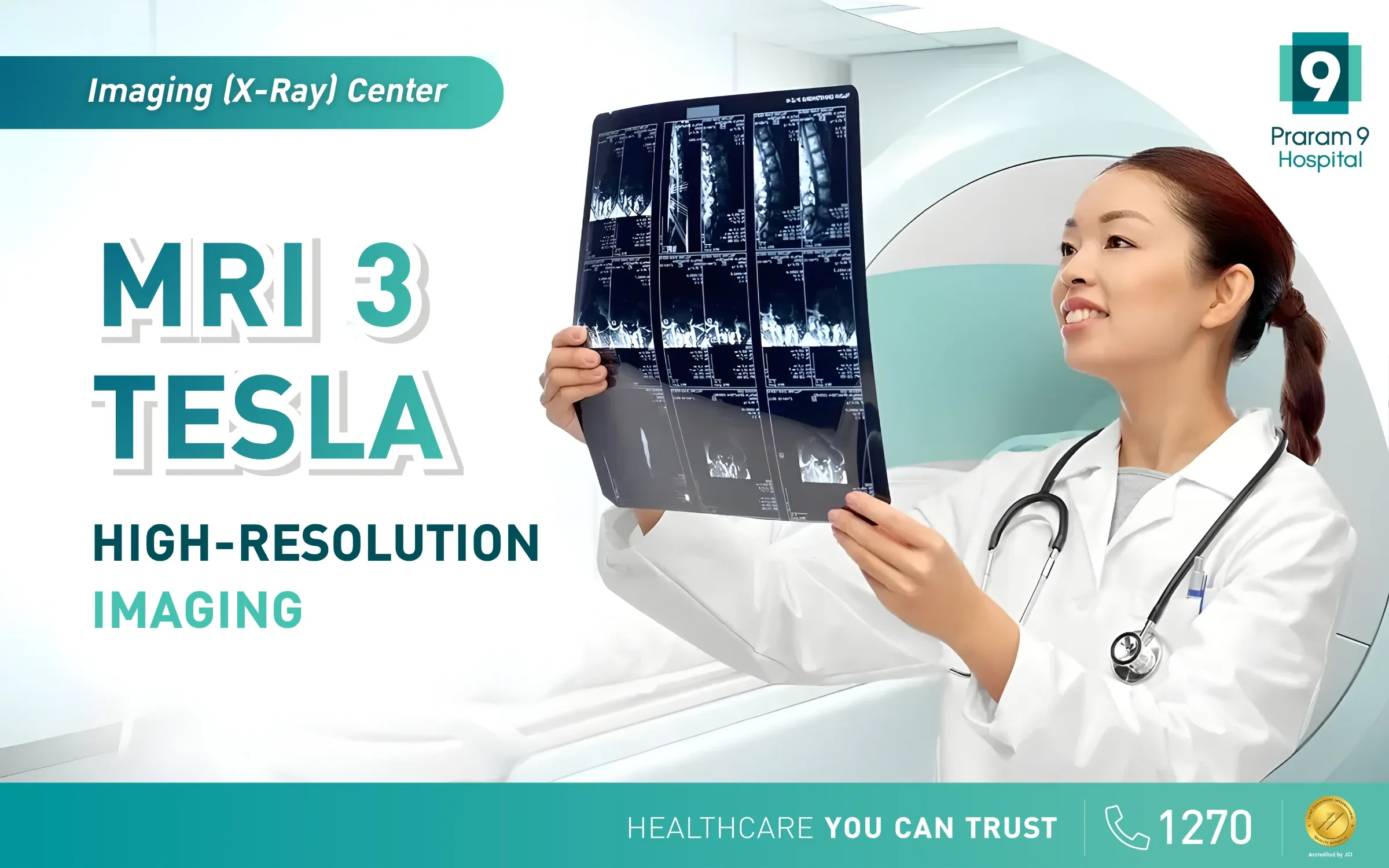
MRI 3 Tesla examination is a diagnostic technology that has become more popular because it provides sharper and more detailed images. However, many people may still wonder how it differs from MRI 1.5 Tesla, including understanding the advantages, disadvantages of MRI, and the possibility of MRI side effects in order to make an appropriate decision.
Key Takeaways
- MRI 3 Tesla is a diagnostic machine that uses a high-strength magnetic field, providing sharper and more detailed images than general examinations.
- Suitable for examining complex diseases such as brain, spinal cord, blood vessels, heart, and joints to help physicians diagnose more accurately.
- Comparison between MRI 3 Tesla and 1.5 Tesla shows higher resolution, able to see small details that may not be detected with standard machines.
- High accuracy, shorter examination time, and does not use X-rays, therefore safe for most patients.
What is MRI 3 Tesla?
MRI 3 Tesla is a diagnostic technology using electromagnetic waves with a high-power magnetic field at 3 Tesla. It can create images that are sharper and more detailed than examinations using the commonly used 1.5 Tesla high-power magnetic field. Suitable for detecting abnormalities of the heart and blood vessels that require high precision.
MRI examines through electromagnetic waves and radio waves to create images of internal body structures, working together with image analysis software, helping physicians examine tissues, heart muscle, and blood vessels in detail.
What are the advantages of MRI 3 Tesla
MRI 3 Tesla examination is an MRI examination that helps make disease diagnosis more accurate, with the following prominent advantages:
- Does not use X-rays, suitable for patients who cannot receive radiation, such as pregnant individuals, those with renal failure*, or those allergic to contrast media (this should be at the physician’s discretion).
- Low side effects, suitable for elderly individuals who may not be able to hold their breath for long, including patients who want to avoid risks from other examination methods.
- New MRI machines have a wider tunnel, accommodating patients with large body size and helping reduce discomfort or claustrophobia.
- Provides sharp and high-resolution images, helping physicians accurately diagnose abnormalities of the heart, blood vessels, and tissues.
- Can be used to assess heart function and examine complex heart diseases without relying on methods that pose risks to the body for evaluation.
However, MRI 3 Tesla examination uses a contrast agent in the group Gadolinium-Based Contrast Agent (GBCA), and some patients may also have allergic reactions. Therefore, before choosing MRI 3 Tesla, medical evaluation should always be completed beforehand.
*For patients with renal failure, kidney function should be evaluated by a physician before every MRI 3 Tesla examination.
Comparison of performance between MRI 3 Tesla and 1.5 Tesla
In electromagnetic wave examination, the higher the magnetic field strength, the sharper the image and the more detailed the detection of abnormalities. Originally, MRI 1.5 Tesla machines were considered the standard used, but MRI 3 Tesla has different performance as follows:
- MRI 3 Tesla provides sharper images, increasing sensitivity in detecting abnormalities of brain tissue, blood vessels, and organs such as ischemic stroke (Stroke) or multiple sclerosis (MS).
- Suitable for brain and nervous system examination. MRI 3 Tesla can visualize details of nerves, brain tissue, and blood flow more clearly, suitable for examination to plan treatment of complex brain diseases.
- Can perform specific techniques. Performing MR Spectroscopy or DTI (Diffusion Tensor Imaging) using MRI 3 Tesla provides more detailed information, helping differentiate tumor types, dementia, and brain infections more accurately than 1.5 Tesla.
- Suitable for vascular examination. Can create clear vascular images both before and after contrast injection, shorter examination time, reducing patient discomfort, helping increase accuracy in treating urgent conditions such as cerebral ischemia.
- Suitable for joint and bone examination (MSK). Provides clearer detail, suitable for evaluating injuries and diseases in the musculoskeletal system.
- Patients do not need to hold their breath for long, but images remain sharp, reducing motion artifacts, making diagnosis of liver, pancreas, kidney, or other abdominal organs more effective.
What diseases can MRI 3 Tesla be used to diagnose
MRI 3 Tesla is used for diagnosing diseases and abnormalities that require higher precision than general examinations. Examples of examinations commonly using MRI 3 Tesla are as follows:
- Cardiovascular diseases: examine ischemic cardiomyopathy, myocarditis, cardiomyopathy from abnormal substance deposition (such as Cardiac Amyloidosis), valvular heart disease, and congenital heart disease.
- Brain and nervous system diseases: used to detect abnormalities of brain tissue, ischemic or hemorrhagic stroke, multiple sclerosis (MS), brain tumors, including evaluation of dementia and Alzheimer’s disease.
- Musculoskeletal system diseases (MSK): helps detect injuries of tendons, cartilage, joints, and diseases related to the spine or degenerative disc disease.
- Abdominal and internal organ diseases: examine liver, pancreas, kidney, and gastrointestinal system while reducing motion artifacts from prolonged breath holding.
- Vascular examination: can create detailed vascular images, including evaluation of stenosis, aneurysm, or vascular abnormalities in various organs.
MRI 3 Tesla limitations and precautions to know
MRI 3 Tesla still has some limitations and precautions that examinees should know beforehand as follows:
- Pregnant or breastfeeding individuals, if contrast agent (Contrast Agent) is required, should consult a physician first.
- Individuals with metal devices implanted in the body. Some implanted devices safe with 1.5 Tesla machines may not be safe with 3 Tesla machines, such as pacemaker, stent, or other implants, which may be affected by the high-strength magnetic field. Therefore, physicians should always be informed.
- Patients with severe kidney disease, especially those with kidney function below 30%, must be evaluated by a specialist beforehand.
- Individuals with claustrophobia. Although new MRI machines have wider tunnels, some patients may still feel uncomfortable and require special care.
MRI 3 Tesla, a new option for more accurate diagnosis
MRI 3 Tesla examination is a technology that increases image sharpness and diagnostic resolution, suitable for those requiring high precision, especially in the brain and nervous system. If looking for MRI examination or having any questions, the Neurology Center, Praram 9 Hospital is recommended, ready to provide services with physicians and fully equipped instruments.
For more information
Facebook: Praram 9 Hospital International & Expats
Line : @Praram9Hospital
Tel. 1270
Frequently asked questions about MRI 3 Tesla machine
1. How can patients prepare before MRI 3 Tesla examination?
All metal, jewelry, and electronic devices should be removed, and the physician should be informed if there is a history of metal implantation or medical devices in the body.
2. How much does MRI 3 Tesla cost?
The cost depends on the organ examined and the medical facility. Generally starts from tens of thousands of baht. The hospital or clinic should be contacted directly for clear information.
References
Marcin, Ashley. (2023, May 1). Everything You Need to Know About Magnetic Resonance Imaging (MRI) Scans. Healthline. https://www.healthline.com/health/what-is-a-mri
MRI (Magnetic Resonance Imaging). (2022, May 9). Cleveland Clinic. https://my.clevelandclinic.org/health/diagnostics/4876-magnetic-resonance-imaging-mri
Sawyers, Tessa. (2025, July 3). CT Scan vs. MRI Scan: Uses, Risks, and What to Expect. Healthline. https://www.healthline.com/health/ct-scan-vs-mri